Korean progress report
- Table of contents
- Introduction
- Goals
- Journey so far
- What I'm doing right now
- Change of pace
- Anki
- Language exchange groups
- So this is how they get me
- Navel gazing
- Artifacting
- Conclusion
Introduction (§)
This is a bit of a journal entry, a bit of a progress report, a bit of a snapshot of my Korean learning progress. I've never given a progress report on my Korean study despite making passing mention of it as far back as 2020 in other articles. There are reasons for this, some of which may become clear in time. But, for other reasons, I have decided it's time I finally do this kind of update.
I would like to make it very clear that the things I say here are thoughts and feelings, not necessarily facts or recommendations unless explicitly stated.
You know that I like for these articles to get long, and I like to think they are complete before publishing. But of course this is something that will never be complete. And although I can tell myself I should wait until the next milestone before this is worth sharing, I can also say that the milestones I've passed so far are worth sharing. And, since it takes some minimum amount of time for me to think and write, this snapshot is really more of a temporal smear anyway. It's nice to have a deadline.
I started studying Korean on October 5, 2018. Day one, hour zero. That day is eight years ago, but I do not say, and I can not say, that I've been studying for eight years, because I haven't. Although eight years have passed, I have fallen off course more than once, more than twice.
In a way, it would be nicer for my ego to not know exactly how much I've studied and how much I haven't. What I mean by that is my skill level is still not very high. This is the crux of the matter. So if I were to say I've been studying for eight years and can not confidently hold an adult conversation, it would be quite a tragedy and a failure, and would reflect very poorly on my abilities and intellect. On the other hand, if I were to say that I've done only one year of "actual study" and seven years of being off course, that would... well, it would still reflect poorly on my discipline, time management, and priorities, but it wouldn't mean I'm quite as stupid. So you see what I mean, it is perhaps better for the ego to not really know for sure.
But of course, we do know for sure, because Anki reveals the truth. I wasn't using Anki from day one, but once I started, it looks like I did two years of consistent, but admittedly not very intensive[1] study. By 2021 the heatmap becomes pale as I was clearly having some days of trying a little harder, and some days of doing the bare minimum to not technically break the streak. This continued through 2022 with light and patchy study and broken streaks. All of 2023, 2024, 2025 represent essentially no study. In May of 2026 I became reinvigorated, which leads us to today.
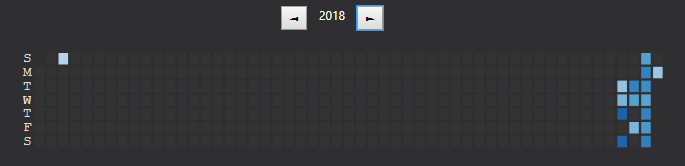
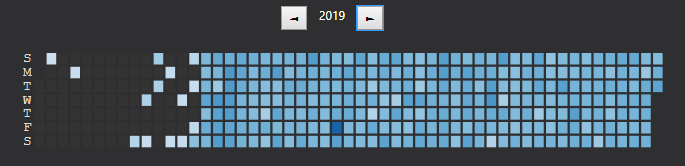
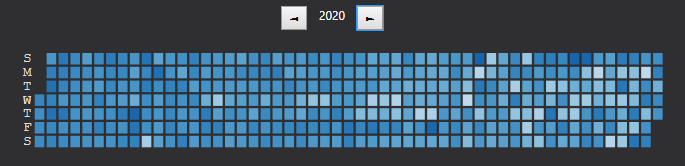
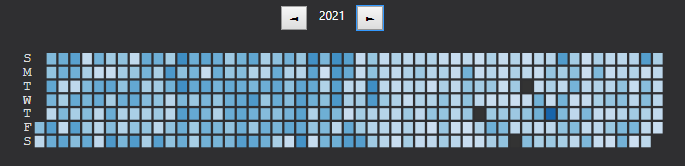
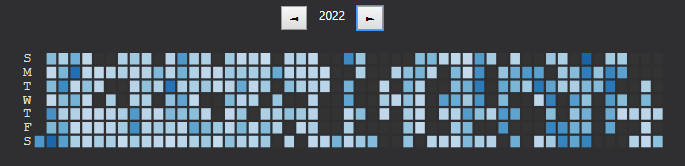
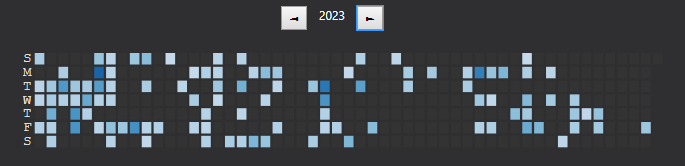
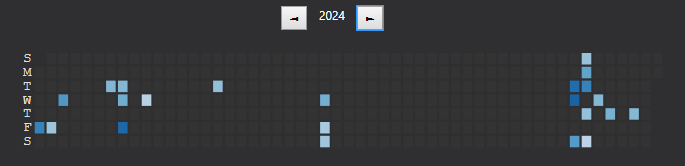
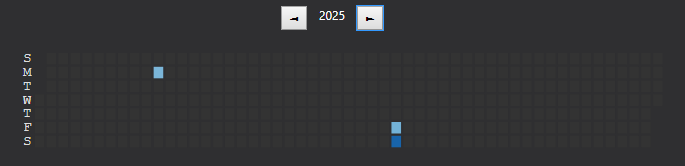
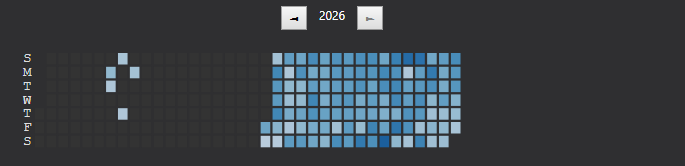
[1] The color scale on the heatmap is relative to each year. The highest day in 2020 barely crests 600 reviews which is now my daily average.
Goals (§)
Why did I start learning Korean at all? I suppose the simplest answer is... 한국여자 예쁘니까. If you're not happy with that answer, you can spare me the comments. I have more thoughts on this than you'd ever want to hear. In fact, I have more thoughts on this than I'd ever want to hear, but they are in my head and I am stuck with them.
In college, and especially during my last year of college, I felt like I was surrounded by people who knew two, three, or even four languages. It made me feel inadequate and pushed me to get back into language. "Back into" meaning that I had taken four years of high school French and one year of college French and couldn't hold an actual conversation, though I did read most of L'Etranger. This kind of experience is pretty common, and has either to do with high school language classes letting everyone off too easily, or the student not having enough intrinsic motivation — understandably since language classes are a school requirement. But anyway, I felt like French wasn't sparking my curiousity at this point in time.
For a period of several years I was very hardcore into watching movies. I watched lots of movies, both domestic and foreign including French, Japanese, Chinese, German, Russian, Swedish, Spanish, Mexican, Thai, Polish, and Minnesotan. There was just something about Korean that I liked the most. Some of my favorites are 친절한 금자씨, 봄, 여름, 가을, 겨울 그리고 봄, and 사마리아. In my article on Ghost Dog I already explored some of the American/Western fascination with East Asia, and I am in this aura as well. I've always liked ninjas. I mean who doesn't like ninjas. So besides French, it was pretty obvious that if I choose to learn another language it would be an Asian language, and amongst the big three CJK, I like Korean the best. Partly this is because every other white person is already obsessed with Japan and I like to avoid doing the most popular thing. Partly this is because I like the sound of Korean more than the sound of Chinese, though Japanese is pretty as well. Partly this is because the Korean alphabet is interesting from both a technical and historical perspective, and makes learning to read so, so, so much easier than the other two.
Then, why have I suddenly become reinvigorated? Well, I recently passed my 30th birthday and... you know how it is when people pass a decade. I've had to think about my priorities and goals in life. For all these years I've been dissatisfied with my Korean study. I have felt like a failure and, despite having an interest in the language, this interest has carried a sense of shame and embarassment because, if I were to want to tell someone anything about it, and if they were to ask me "oh, you know Korean?" my answer would truthfully be "uh, not really". So it has been a kind of secret that I carry and don't tell anyone about because all it does is reveal my failure. So, it's time for me to really do this, and take it more seriously, and not be a failure. I am the kind of person that goes through lots of hobby phases and dabbles in all kinds of things and very explicitly does not intend to become an expert in all of them. But the fact that I'm still interested in Korean after all this time seems to suggest it's not just one of those phases.
To be more precise, my wave of renewed motivation started after Matt vs Japan uploaded a new video, which led me to discover that he actually has a second channel now, and also to rewatch a lot of his older videos. The content of the video that re-motivated me wasn't particularly out of the ordinary for Matt. It was just good timing.
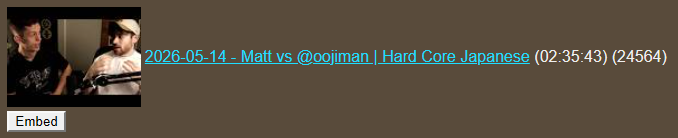
In some circles, Matt has earned a negative reputation, but I'm not part of all that and that's not my relationship to the material he's made. I've never paid for anyone's courses or resources of any kind, I just watch the videos he's made for free and, as far as I'm concerned, his information is both good and motivational. The ideas and philosophies behind input-centric study resonate with me. You may like to read my previous article Are children better at learning languages? for more thoughts on that.
Suffice to say, I appreciate the things Matt has shared during his language learning journey of over fifteen years, and this is part of the reason I feel I should express my own thoughts here.
To say a little more about these goals and priorities brings us back to 한국여자 예쁘다. By the time you get to the age of 30, everyone around you is trying to get out of the dating phase. Everyone is "dating with intention" and "looking for my future husband" and "done wasting time". So I don't want to waste anybody's time who feels like their clock is ticking and, if I meet someone who isn't Korean, no matter how nice and sweet and pretty she may be, what would I do with all this Korean? There are plenty of pretty girls out there that I wouldn't mind spending time with, but at the moment I cannot see myself becoming committed with someone not Korean. Not until I have some catastrophic crash-and-burn disaster relationship that changes my mind, perhaps. I won't bore you with the rest of my thoughts on this, now. So the other option is to get back in there and actually learn it this time.
Journey so far (§)
When someone asks me how I learned Korean, my answer is... well my answer is 아직 안 배웠는데?. But let me try to give you an idea of the study resources I've used on my journey so far. I have not taken any classes or worked through any textbooks.
On my very first day of study in 2018, I downloaded Duolingo. I used it for a few weeks and decided it was not very good, and the consensus online at the time was that their material for Korean was not good, so I deleted it.
I next used Lingodeer for a period of a few weeks or a few months, and it was probably better than Duolingo but truthfully I don't remember very much about it.
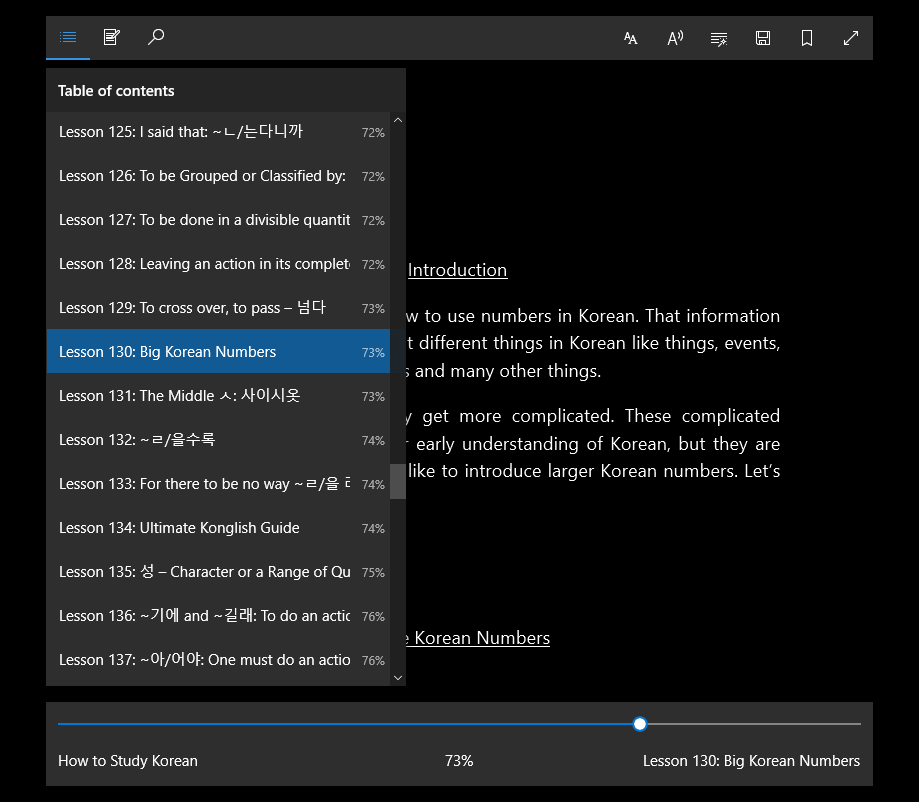
For the first few months of my study, I was reading through the lessons on howtostudykorean.com. This is where I got my grasp on the alphabet, pronunciation, and basic grammar points. Although I have not done a critical re-read of his lessons since then, my memories of HTSK are positive and I would recommend them, especially since they're all free. Being the type of person that I am, I've even downloaded all the webpages and turned them into an epub ebook file.
In December 2018 I downloaded HelloTalk, which is an app that connects you with someone for language exchange. This is not an endorsement since I haven't used it since then and don't know what their reputation is in 2026. On HelloTalk, I met someone that I liked and, by April 2019, we were in a long-distance romantic relationship. Of course, there was the goal of meeting up, but between the impacts of Covid, some changes in her educational and career goals, and my cowardice to take a leap, this did not happen, and we eventually broke up in 2022.
The truth is, she and I never had any significant conversations in Korean. Her English skill was very good, my Korean skill was not very good, and I did not have the courage to be willing to fail in the way you need to to speak a language. So our conversations were always in English. But we did read catlab articles and fairy tales together. Although I did not do very much language study with her, I learned lots of cultural touchpoints and the kinds of things you don't get from a textbook. You know, like this.
My primary listening resource has been Talk To Me In Korean's Iyagi series, which ran most of its course from 2010 to 2012. These are 5-10 minute conversations between two members of the TTMIK team. They used to be all available for free on Soundcloud, and I downloaded them along with the transcripts. The episodes are no longer available for free. I have listened to each of these 145 episodes so so so so so many times by now. Some of them are still difficult for me, although some of them I can follow pretty well. The reason the harder ones are still hard is because I just haven't taken the time to thoroughly scour the transcripts for whatever it is that I'm missing. In a way, I do feel that it has been an imperfect use of my time to listen to material so high above my skill level for most of this period, and I would have been better served by some more comprehensible input. But, I've always liked the fact that in Iyagi they strike a good balance of speaking clearly and properly (because they know their audience is learners), without speaking baby-talk or dumbing it down. It is difficult to find a resource that is at the right skill level and also available in large quantities to download, though part of that difficulty is just the friction of stepping out of my comfort zone to go search for something new.
My primary reading resource has been fairy tales (전래동화). I said I've never paid for any resources but, well, I guess I've found other ways of getting them. I have a large book of 전래동화 and have read through quite a few. It's neat to learn some of the stories that most Korean people would probably know from their own childhood. Though, there are some stories where nobody did anything wrong and everyone dies and I wonder what was the point.
When you put this all together, my study regimen so far has been fairy tales, a single defunct podcast, and branching through the dictionary to find more words? It's no surprise I'm not an expert yet. But somehow it seems like my results are coming along ok, considering.
What I'm doing right now (§)
At the moment, I'm in the mood to absolutely cram vocabulary. I have much more to say specifically about Anki in a few minutes, but basically, I am trying to do 100 new words per day and am averaging 600-1000 reviews per day, which takes me between 60-90 minutes. On the Anki forums, people recommend 20 new words per day as a starting point and say that, depending on your parameters, you can expect to do 7x to 10x your New quantity per day in reviews. Some of that information comes from the days before FSRS but it's a general guideline. Looking at my historical Anki heatmap, it seems I was probably living by those guidelines since I seldom did over 200 reviews back in the day.
During my recent restart, though, I realized... my entire Anki collection only has about 7,000 cards (which is now over 8,000 as I've been adding more), and I thought if I can do 100 new per day, I'll get through the whole deck in just 70 days. That's over 1% of the collection in new per day! That doesn't mean I'll have all 7,000 cards perfectly memorized, and certainly not perfectly acquired, of course, but at least they'll be in rotation, they'll have seeds planted in my brain, they'll be hooks into the listening that I do and, really, 70 days is not a long time at all. In the grand scheme of things, across all the time that I've spent studying and all the time that I've not spent studying, 70 days is truly nothing.
To tell the truth, I do simply enjoy the party-trick aspect of having a high vocabulary, even if I can hardly use these words in a sentence. I know that memorizing low-frequency words is not the most important thing I could be doing with my time. But again, wasting a little bit of time over 70 days is a paltry sin compared to the past three years during which I've done absolutely no study at all.
Having a high vocabulary really does make listening so much easier, because your brain has a larger set of candidate words to work with, whereas if you have a small vocabulary it is hard to know what might have been a word and what might have been two words and what might have been a grammar form. Furthermore, it is a misconception to think that low-corpus-frequency words are less important to learn. They're often the words that define the entire point of the conversation. So to think that within the next 70 days I can at least pat myself on the back for having 7,000 words under my belt seems like a very worthwhile trade.
And 60-90 minutes is really not that hard to accomplish. I have found that I am really bad at studying while I'm at home, though. At home, I get distracted too easily and can hardly get myself to do more than 50 reviews before closing Anki for reasons that I don't fully understand. I have to get out of the house, so I go sit in the nearby plaza and do my reviews out there. On some days, I've been there for nearly three hours doing reviews, digging through the dictionary, looking up images of vocabulary, making new cards, and updating my existing cards.
I will go ahead and clarify that when I say "party trick", I mean of course that is it relative to the rest of my abilities. On an absolute scale, I am still learning basic words — card #7945 in my collection is 기저귀. Diaper. It is only a party trick in the sense that after someone rightfully judges my ability to be fairly low, they'll be impressed that I know words like 백수, 격주, 맨투맨, 줄임말. Those are from experience.
In 2024, I did a massive reset on my Anki cards to set them all back to "new" status, because I had not kept up on my reviews. I decided it was better to reset them all and let the easy ones graduate again rather than wreak havoc on the intervals. Of course I didn't actually start studying again in 2024, but anyway. So although I am doing 100 "new" cards per day, a lot of these are actually coming back to me very quickly, and it's not the same as actually encountering 100 new words from scratch, and my experience of doing Anki this way is not the same as it would be for someone who's actually starting right now.
There are of course some days that I don't finish all my scheduled reviews, which mainly are the days that I go to language exchange. On those days I am up in the morning at 5:30, working until 4:00, driving until 5:00, have 2 hours until the meeting, and am not back home until 10:00-11:00. So those two hours from 5:00 to 7:00 are my time to eat dinner and do some Anki, but also I take this opportunity to explore some of the local points of interest because I don't normally spend much time over there. I'd rather visit some places I've never been before than sit in my car doing Anki before the meeting starts. So usually I have a backlog to catch up on Fridays.
I wrote the above a few weeks ago and, unsurprisingly, my hubris has caught up with me. I am intentionally trying to keep my life as busy as possible, getting out and meeting people and all that. Even 60 minutes of study is not always attainable. Also, the past few weeks of August have been way too hot outside, making it impossible to sit in my usual plaza spot for study, and I truly am unable to bring myself to study at home.
So, I have now gone several weeks without breaking through the due cards into the new. This slows down my "70 days" timeline into at least 90-100 days minimum, and that's only if I can get back on track and stay there. But that's ok, this is still quick in the grand scheme, and some of the things I've been doing with my time are more important than Anki.
As I near the publication date of this article, I'm at the point where my remaining count of New cards is lower than my typical Saturday/Sunday review count. Should I...?
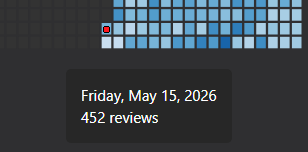
Here's my Anki stats from this time period. I wrote a quick and dirty, non-optimized script to pull the point-in-time history: ankipit.py. I'm not sure my method was 100% correct but it's pretty close.
| date | total cards | new | learning | relearning | young | mature | studied today | mature retention | new studied |
|---|---|---|---|---|---|---|---|---|---|
| 2026-05-14 (목) | 6754 | 6604 | 29 | 0 | 121 | 0 | 0 | 0/0 (n/a) | 0 |
| 2026-05-15 (금) | 6754 | 6510 | 21 | 0 | 223 | 0 | 452 | 0/0 (n/a) | 94 |
| 2026-05-16 (토) | 6755 | 6511 | 21 | 0 | 223 | 0 | 4 | 0/0 (n/a) | 0 |
| 2026-05-17 (일) | 6755 | 6493 | 19 | 0 | 243 | 0 | 82 | 0/0 (n/a) | 18 |
| 2026-05-18 (월) | 6761 | 6191 | 109 | 2 | 456 | 3 | 1026 | 0/0 (n/a) | 308 |
| 2026-05-19 (화) | 6761 | 6191 | 107 | 2 | 458 | 3 | 713 | 0/0 (n/a) | 303 |
| 2026-05-20 (수) | 6763 | 6193 | 107 | 2 | 458 | 3 | 641 | 0/0 (n/a) | 176 |
| 2026-05-21 (목) | 6767 | 6197 | 107 | 2 | 458 | 3 | 1040 | 0/0 (n/a) | 232 |
| 2026-05-22 (금) | 6767 | 6197 | 107 | 2 | 458 | 3 | 230 | 0/0 (n/a) | 102 |
| 2026-05-23 (토) | 6767 | 6197 | 107 | 2 | 458 | 3 | 10 | 0/0 (n/a) | 0 |
| 2026-05-24 (일) | 6768 | 6198 | 107 | 2 | 458 | 3 | 582 | 0/0 (n/a) | 154 |
| 2026-05-25 (월) | 6768 | 6198 | 107 | 2 | 458 | 3 | 35 | 0/0 (n/a) | 0 |
| 2026-05-26 (화) | 6772 | 6202 | 107 | 2 | 458 | 3 | 182 | 0/0 (n/a) | 15 |
| 2026-05-27 (수) | 6772 | 6202 | 107 | 2 | 458 | 3 | 112 | 0/0 (n/a) | 11 |
| 2026-05-28 (목) | 6777 | 6207 | 107 | 2 | 458 | 3 | 348 | 0/0 (n/a) | 100 |
| 2026-05-29 (금) | 6779 | 6209 | 107 | 2 | 458 | 3 | 42 | 0/0 (n/a) | 0 |
| 2026-05-30 (토) | 6783 | 6213 | 107 | 2 | 458 | 3 | 625 | 0/0 (n/a) | 174 |
| 2026-05-31 (일) | 6794 | 6224 | 107 | 2 | 458 | 3 | 440 | 0/0 (n/a) | 64 |
| 2026-06-01 (월) | 6799 | 6229 | 107 | 2 | 458 | 3 | 838 | 0/0 (n/a) | 213 |
| 2026-06-02 (화) | 6800 | 6230 | 107 | 2 | 458 | 3 | 202 | 0/0 (n/a) | 0 |
| 2026-06-03 (수) | 6803 | 6233 | 107 | 2 | 458 | 3 | 165 | 0/0 (n/a) | 2 |
| 2026-06-04 (목) | 6803 | 6233 | 9 | 55 | 435 | 71 | 463 | 0/0 (n/a) | 0 |
| 2026-06-05 (금) | 6807 | 6235 | 1 | 3 | 477 | 91 | 182 | 0/0 (n/a) | 2 |
| 2026-06-06 (토) | 6831 | 6162 | 13 | 0 | 470 | 186 | 664 | 0/0 (n/a) | 99 |
| 2026-06-07 (일) | 6845 | 5918 | 0 | 0 | 741 | 186 | 935 | 0/0 (n/a) | 258 |
| 2026-06-08 (월) | 6850 | 5914 | 8 | 6 | 728 | 194 | 376 | 0/0 (n/a) | 9 |
| 2026-06-09 (화) | 6852 | 5818 | 0 | 0 | 759 | 275 | 577 | 0/0 (n/a) | 99 |
| 2026-06-10 (수) | 6862 | 5629 | 0 | 0 | 842 | 391 | 1055 | 0/0 (n/a) | 200 |
| 2026-06-11 (목) | 6868 | 5506 | 13 | 0 | 867 | 482 | 815 | 0/0 (n/a) | 129 |
| 2026-06-12 (금) | 6887 | 5522 | 3 | 12 | 856 | 494 | 348 | 0/0 (n/a) | 4 |
| 2026-06-13 (토) | 6899 | 5484 | 6 | 1 | 898 | 510 | 427 | 0/0 (n/a) | 50 |
| 2026-06-14 (일) | 6909 | 5444 | 0 | 0 | 914 | 551 | 486 | 0/0 (n/a) | 50 |
| 2026-06-15 (월) | 6934 | 5419 | 0 | 0 | 933 | 582 | 390 | 0/0 (n/a) | 50 |
| 2026-06-16 (화) | 6952 | 5382 | 5 | 0 | 957 | 608 | 415 | 0/0 (n/a) | 55 |
| 2026-06-17 (수) | 6972 | 5352 | 15 | 0 | 970 | 635 | 320 | 0/0 (n/a) | 50 |
| 2026-06-18 (목) | 6991 | 5269 | 4 | 0 | 1026 | 692 | 507 | 0/0 (n/a) | 102 |
| 2026-06-19 (금) | 6996 | 5198 | 44 | 0 | 1020 | 734 | 387 | 0/0 (n/a) | 76 |
| 2026-06-20 (토) | 6996 | 5198 | 10 | 17 | 1026 | 745 | 210 | 0/0 (n/a) | 0 |
| 2026-06-21 (일) | 7034 | 5036 | 29 | 0 | 1130 | 839 | 783 | 0/0 (n/a) | 200 |
| 2026-06-22 (월) | 7062 | 4964 | 24 | 0 | 1172 | 902 | 668 | 0/0 (n/a) | 100 |
| 2026-06-23 (화) | 7069 | 4871 | 28 | 0 | 1210 | 960 | 583 | 0/0 (n/a) | 100 |
| 2026-06-24 (수) | 7089 | 4790 | 18 | 0 | 1241 | 1040 | 610 | 0/0 (n/a) | 101 |
| 2026-06-25 (목) | 7094 | 4696 | 65 | 2 | 1220 | 1111 | 520 | 0/0 (n/a) | 100 |
| 2026-06-26 (금) | 7097 | 4696 | 44 | 2 | 1244 | 1111 | 88 | 0/0 (n/a) | 3 |
| 2026-06-27 (토) | 7119 | 4618 | 25 | 0 | 1263 | 1213 | 904 | 2/2 (100.0%) | 100 |
| 2026-06-28 (일) | 7147 | 4535 | 8 | 0 | 1329 | 1275 | 663 | 1/1 (100.0%) | 111 |
| 2026-06-29 (월) | 7167 | 4456 | 24 | 0 | 1367 | 1320 | 618 | 2/3 (66.7%) | 100 |
| 2026-06-30 (화) | 7169 | 4357 | 63 | 4 | 1380 | 1365 | 572 | 1/1 (100.0%) | 101 |
| 2026-07-01 (수) | 7181 | 4269 | 38 | 1 | 1465 | 1408 | 712 | 4/4 (100.0%) | 100 |
| 2026-07-02 (목) | 7181 | 4268 | 10 | 9 | 1484 | 1410 | 537 | 6/7 (85.7%) | 1 |
| 2026-07-03 (금) | 7184 | 4171 | 28 | 0 | 1530 | 1455 | 628 | 6/6 (100.0%) | 100 |
| 2026-07-04 (토) | 7208 | 4095 | 68 | 4 | 1554 | 1487 | 635 | 6/9 (66.7%) | 100 |
| 2026-07-05 (일) | 7321 | 4108 | 15 | 0 | 1663 | 1535 | 867 | 6/9 (66.7%) | 100 |
| 2026-07-06 (월) | 7332 | 4019 | 36 | 0 | 1701 | 1576 | 746 | 14/19 (73.7%) | 100 |
| 2026-07-07 (화) | 7346 | 3933 | 30 | 0 | 1769 | 1614 | 796 | 18/20 (90.0%) | 100 |
| 2026-07-08 (수) | 7351 | 3938 | 9 | 24 | 1758 | 1622 | 355 | 9/11 (81.8%) | 0 |
| 2026-07-09 (목) | 7352 | 3939 | 1 | 17 | 1766 | 1629 | 429 | 27/31 (87.1%) | 0 |
| 2026-07-10 (금) | 7352 | 3939 | 0 | 24 | 1757 | 1632 | 139 | 7/8 (87.5%) | 0 |
| 2026-07-11 (토) | 7376 | 3853 | 31 | 0 | 1811 | 1681 | 1357 | 80/97 (82.5%) | 110 |
| 2026-07-12 (일) | 7394 | 3771 | 16 | 0 | 1897 | 1710 | 887 | 41/51 (80.4%) | 101 |
| 2026-07-13 (월) | 7394 | 3671 | 71 | 14 | 1892 | 1746 | 742 | 44/52 (84.6%) | 100 |
| 2026-07-14 (화) | 7406 | 3680 | 24 | 26 | 1933 | 1743 | 484 | 28/35 (80.0%) | 3 |
| 2026-07-15 (수) | 7407 | 3681 | 1 | 23 | 1958 | 1744 | 571 | 30/37 (81.1%) | 0 |
| 2026-07-16 (목) | 7413 | 3685 | 1 | 9 | 1970 | 1748 | 438 | 35/40 (87.5%) | 2 |
| 2026-07-17 (금) | 7414 | 3586 | 73 | 3 | 1981 | 1771 | 1098 | 116/137 (84.7%) | 100 |
| 2026-07-18 (토) | 7458 | 3530 | 23 | 0 | 2086 | 1819 | 847 | 58/66 (87.9%) | 100 |
| 2026-07-19 (일) | 7463 | 3535 | 5 | 19 | 2079 | 1825 | 433 | 34/37 (91.9%) | 0 |
| 2026-07-20 (월) | 7478 | 3450 | 22 | 0 | 2139 | 1867 | 1007 | 88/96 (91.7%) | 100 |
| 2026-07-21 (화) | 7492 | 3353 | 36 | 0 | 2196 | 1907 | 895 | 52/59 (88.1%) | 111 |
| 2026-07-22 (수) | 7492 | 3352 | 14 | 18 | 2200 | 1908 | 331 | 16/22 (72.7%) | 1 |
| 2026-07-23 (목) | 7507 | 3367 | 1 | 5 | 2226 | 1908 | 293 | 19/21 (90.5%) | 0 |
| 2026-07-24 (금) | 7515 | 3375 | 0 | 27 | 2206 | 1907 | 469 | 30/40 (75.0%) | 0 |
| 2026-07-25 (토) | 7538 | 3249 | 21 | 0 | 2270 | 1998 | 2069 | 383/408 (93.9%) | 149 |
| 2026-07-26 (일) | 7599 | 3161 | 7 | 0 | 2304 | 2127 | 1194 | 52/57 (91.2%) | 149 |
| 2026-07-27 (월) | 7606 | 3068 | 45 | 3 | 2327 | 2163 | 814 | 41/42 (97.6%) | 100 |
| 2026-07-28 (화) | 7609 | 2971 | 52 | 7 | 2353 | 2226 | 1024 | 39/42 (92.9%) | 100 |
| 2026-07-29 (수) | 7615 | 2878 | 60 | 0 | 2422 | 2255 | 999 | 34/37 (91.9%) | 100 |
| 2026-07-30 (목) | 7621 | 2884 | 34 | 8 | 2442 | 2253 | 306 | 6/9 (66.7%) | 0 |
| 2026-07-31 (금) | 7624 | 2787 | 38 | 5 | 2464 | 2330 | 1447 | 57/62 (91.9%) | 100 |
| 2026-08-01 (토) | 7633 | 2796 | 12 | 1 | 2494 | 2330 | 189 | 2/2 (100.0%) | 0 |
| 2026-08-02 (일) | 7673 | 2667 | 3 | 0 | 2585 | 2418 | 1724 | 51/57 (89.5%) | 170 |
| 2026-08-03 (월) | 7674 | 2668 | 0 | 1 | 2587 | 2418 | 28 | 2/2 (100.0%) | 0 |
| 2026-08-04 (화) | 7680 | 2629 | 12 | 6 | 2601 | 2432 | 537 | 15/16 (93.8%) | 45 |
| 2026-08-05 (수) | 7682 | 2630 | 0 | 27 | 2598 | 2427 | 562 | 23/29 (79.3%) | 1 |
| 2026-08-06 (목) | 7695 | 2643 | 0 | 17 | 2613 | 2422 | 796 | 40/48 (83.3%) | 0 |
| 2026-08-07 (금) | 7699 | 2646 | 0 | 11 | 2619 | 2423 | 825 | 39/44 (88.6%) | 1 |
| 2026-08-08 (토) | 7701 | 2648 | 0 | 0 | 2629 | 2424 | 68 | 3/3 (100.0%) | 0 |
| 2026-08-09 (일) | 7713 | 2560 | 42 | 1 | 2635 | 2475 | 1548 | 63/67 (94.0%) | 100 |
| 2026-08-10 (월) | 7716 | 2538 | 19 | 19 | 2640 | 2500 | 559 | 22/24 (91.7%) | 25 |
| 2026-08-11 (화) | 7718 | 2470 | 35 | 26 | 2637 | 2550 | 674 | 25/29 (86.2%) | 70 |
| 2026-08-12 (수) | 7720 | 2472 | 0 | 4 | 2662 | 2582 | 895 | 31/34 (91.2%) | 0 |
| 2026-08-13 (목) | 7736 | 2488 | 1 | 4 | 2634 | 2609 | 686 | 31/34 (91.2%) | 0 |
| 2026-08-14 (금) | 7737 | 2489 | 0 | 13 | 2622 | 2613 | 95 | 6/6 (100.0%) | 0 |
| 2026-08-15 (토) | 7738 | 2490 | 0 | 18 | 2592 | 2638 | 1125 | 57/63 (90.5%) | 0 |
| 2026-08-16 (일) | 7740 | 2470 | 0 | 8 | 2603 | 2659 | 408 | 30/35 (85.7%) | 22 |
| 2026-08-17 (월) | 7755 | 2385 | 39 | 0 | 2618 | 2713 | 1338 | 80/96 (83.3%) | 100 |
| 2026-08-18 (화) | 7757 | 2287 | 68 | 4 | 2634 | 2764 | 867 | 59/65 (90.8%) | 100 |
| 2026-08-19 (수) | 7759 | 2262 | 40 | 1 | 2685 | 2771 | 204 | 0/1 (0.0%) | 27 |
| 2026-08-20 (목) | 7766 | 2268 | 15 | 9 | 2705 | 2769 | 91 | 0/2 (0.0%) | 1 |
| 2026-08-21 (금) | 7766 | 2268 | 4 | 6 | 2718 | 2770 | 223 | 14/16 (87.5%) | 0 |
| 2026-08-22 (토) | 7766 | 2268 | 0 | 3 | 2723 | 2772 | 93 | 3/3 (100.0%) | 0 |
| 2026-08-23 (일) | 7789 | 2291 | 0 | 5 | 2706 | 2787 | 596 | 43/47 (91.5%) | 0 |
| 2026-08-24 (월) | 7795 | 2297 | 0 | 2 | 2690 | 2806 | 382 | 31/33 (93.9%) | 0 |
| 2026-08-25 (화) | 7804 | 2306 | 0 | 0 | 2674 | 2824 | 358 | 48/51 (94.1%) | 0 |
| 2026-08-26 (수) | 7809 | 2311 | 0 | 75 | 2572 | 2851 | 561 | 94/97 (96.9%) | 0 |
| 2026-08-27 (목) | 7811 | 2313 | 0 | 15 | 2630 | 2853 | 115 | 8/9 (88.9%) | 0 |
| 2026-08-28 (금) | 7811 | 2313 | 0 | 2 | 2636 | 2860 | 166 | 37/37 (100.0%) | 0 |
| 2026-08-29 (토) | 7831 | 2333 | 0 | 11 | 2623 | 2864 | 109 | 24/26 (92.3%) | 0 |
| 2026-08-30 (일) | 7836 | 2338 | 0 | 66 | 2502 | 2930 | 920 | 145/156 (92.9%) | 0 |
| 2026-08-31 (월) | 7842 | 2344 | 0 | 8 | 2514 | 2976 | 722 | 98/107 (91.6%) | 0 |
| 2026-09-01 (화) | 7845 | 2345 | 0 | 18 | 2454 | 3028 | 711 | 132/140 (94.3%) | 2 |
| 2026-09-02 (수) | 7851 | 2349 | 0 | 15 | 2437 | 3050 | 256 | 54/60 (90.0%) | 2 |
| 2026-09-03 (목) | 7854 | 2352 | 0 | 4 | 2439 | 3059 | 138 | 32/35 (91.4%) | 0 |
| 2026-09-04 (금) | 7854 | 2352 | 0 | 11 | 2407 | 3084 | 158 | 30/32 (93.8%) | 0 |
| 2026-09-05 (토) | 7860 | 2358 | 0 | 0 | 2399 | 3103 | 151 | 27/27 (100.0%) | 0 |
| 2026-09-06 (일) | 7868 | 2366 | 0 | 21 | 2345 | 3136 | 882 | 126/129 (97.7%) | 0 |
| 2026-09-07 (월) | 7875 | 2273 | 62 | 3 | 2314 | 3223 | 1577 | 274/290 (94.5%) | 100 |
| 2026-09-08 (화) | 7879 | 2174 | 53 | 6 | 2392 | 3254 | 689 | 62/67 (92.5%) | 103 |
| 2026-09-09 (수) | 7882 | 2077 | 75 | 25 | 2423 | 3282 | 819 | 63/67 (94.0%) | 100 |
| 2026-09-10 (목) | 7886 | 2078 | 73 | 15 | 2438 | 3282 | 35 | 0/0 (n/a) | 3 |
| 2026-09-11 (금) | 7892 | 2084 | 35 | 2 | 2490 | 3281 | 126 | 0/1 (0.0%) | 0 |
| 2026-09-12 (토) | 7909 | 2101 | 1 | 12 | 2500 | 3295 | 755 | 60/63 (95.2%) | 0 |
| 2026-09-13 (일) | 7918 | 2110 | 0 | 7 | 2506 | 3295 | 118 | 14/14 (100.0%) | 0 |
| 2026-09-14 (월) | 7927 | 2119 | 0 | 7 | 2501 | 3300 | 117 | 17/17 (100.0%) | 0 |
| 2026-09-15 (화) | 7935 | 2127 | 0 | 15 | 2476 | 3317 | 654 | 83/87 (95.4%) | 0 |
| 2026-09-16 (수) | 7940 | 2132 | 0 | 12 | 2475 | 3321 | 133 | 19/20 (95.0%) | 0 |
| 2026-09-17 (목) | 7944 | 2136 | 0 | 19 | 2455 | 3334 | 417 | 54/59 (91.5%) | 0 |
| 2026-09-18 (금) | 7944 | 2136 | 0 | 11 | 2462 | 3335 | 52 | 8/9 (88.9%) | 0 |
| 2026-09-19 (토) | 7944 | 2136 | 2 | 159 | 2258 | 3389 | 1024 | 187/199 (94.0%) | 0 |
| 2026-09-20 (일) | 7960 | 1952 | 76 | 15 | 2397 | 3520 | 2026 | 225/239 (94.1%) | 200 |
| 2026-09-21 (월) | 7960 | 1752 | 122 | 9 | 2474 | 3603 | 1086 | 65/68 (95.6%) | 200 |
| 2026-09-22 (화) | 7961 | 1553 | 180 | 70 | 2479 | 3679 | 1102 | 66/68 (97.1%) | 200 |
| 2026-09-23 (수) | 7961 | 1553 | 79 | 74 | 2575 | 3680 | 767 | 35/39 (89.7%) | 0 |
| 2026-09-24 (목) | 7963 | 1408 | 115 | 54 | 2636 | 3750 | 1422 | 93/100 (93.0%) | 147 |
| 2026-09-25 (금) | 7970 | 1415 | 98 | 17 | 2690 | 3750 | 85 | 0/0 (n/a) | 0 |
| 2026-09-26 (토) | 7971 | 1416 | 51 | 98 | 2649 | 3757 | 727 | 58/66 (87.9%) | 0 |
| 2026-09-27 (일) | 7982 | 1427 | 3 | 18 | 2757 | 3777 | 1380 | 105/116 (90.5%) | 0 |
| 2026-09-28 (월) | 7988 | 1390 | 22 | 15 | 2760 | 3801 | 912 | 78/83 (94.0%) | 43 |
| 2026-09-29 (화) | 7992 | 1194 | 97 | 6 | 2837 | 3858 | 1055 | 53/62 (85.5%) | 200 |
| 2026-09-30 (수) | 7994 | 1194 | 42 | 23 | 2877 | 3858 | 275 | 6/7 (85.7%) | 2 |
| 2026-10-01 (목) | 8001 | 1201 | 14 | 48 | 2880 | 3858 | 598 | 37/40 (92.5%) | 0 |
| 2026-10-02 (금) | 8002 | 1202 | 7 | 10 | 2925 | 3858 | 67 | 0/0 (n/a) | 0 |
| 2026-10-03 (토) | 8002 | 1202 | 0 | 66 | 2858 | 3876 | 1746 | 143/157 (91.1%) | 0 |
| 2026-10-04 (일) | 8013 | 1013 | 142 | 4 | 2907 | 3947 | 1252 | 96/103 (93.2%) | 200 |
I have had some difficulty finding youtube channels that are of an appropriate difficulty level and are enjoyable to watch. One channel I've found recently is 태웅쌤 - Comprehensible Input Korean. He plays video games and describes / narrates what he's doing using easy sentences, but again not baby talk. I think video games are good idea as a source of comprehensible input since he can point to things on screen and describe what's happening without having to give any English translations.
Change of pace (§)
I have spent quite a lot of time describing the ways in which I have failed. Failed to study, failed to speak, failed to be brave, etc. Let's have a slight change of tone here by saying something I am good at. I have always enjoyed listening to international accents and doing voices and, in my own opinion, I think my pronunciation is okay, though of course I will not say perfect or great. All of the Korean people I've met tell me that my pronunciation is good, always unprompted, but still I am careful to accept it. When I am doing a cold read on a new piece of text, I still have to go slow, and my rhythm is poor. I am not able to sight read yet because there is still so much vocabulary that I don't know. Even in English, you know it's hard to sight read quickly through a text that contains too much unknown vocubulary, such as something very dense with domain-specific jargon, so that's kind of how this feels all the time.
Agh, wait, this was the positive part. Anyway, when I am reading something that I'm familiar, I think I sound not terrible. Here:
요즘에 한국어를 열심히 공부하고 있습니다. 매일 Anki로 어휘를 공부하고, 운전할 때 팥케스트를 들어가요. 매주 목요일 일을 끝나서 얼바인에서 한영 언어 교환 모임에 가요. 그리고 격주, 이 주에 한 번씩, 수요일 OC 소스 몰에서 다른 모임도이 있어요. 집에서 혼자 있을 때나, 팥케스트를 들 때는, 제가 잘한다고, 많이 이해할 수 있다고 생각해요. 근데 현실의 상대방이랑 직접 얘기하면 참 어렵잖아요! 제 생각에는, 제 발음이 괜찮는데, 억양이나 진짜 문장을 만들기가 힘들다. 언어 교환 친구들이 다 착하고 응원해 주고 힘이 되어주세요.
와, 한국어에 관한 기사에 한국어 문단이 있네! 문법이 맞는지 틀린지, 표현이 자연스러운지 잘 모르겠는데, 재밌군요.
Listening to this, I think I need to fix my "서", but I'll leave it for now.
Anki (§)
I will describe to you my note and card templates, some practices I've been doing since the beginning that I'm glad for, some practices I wish I had done since the beginning, and some practices that I was doing at the beginning but have stopped.
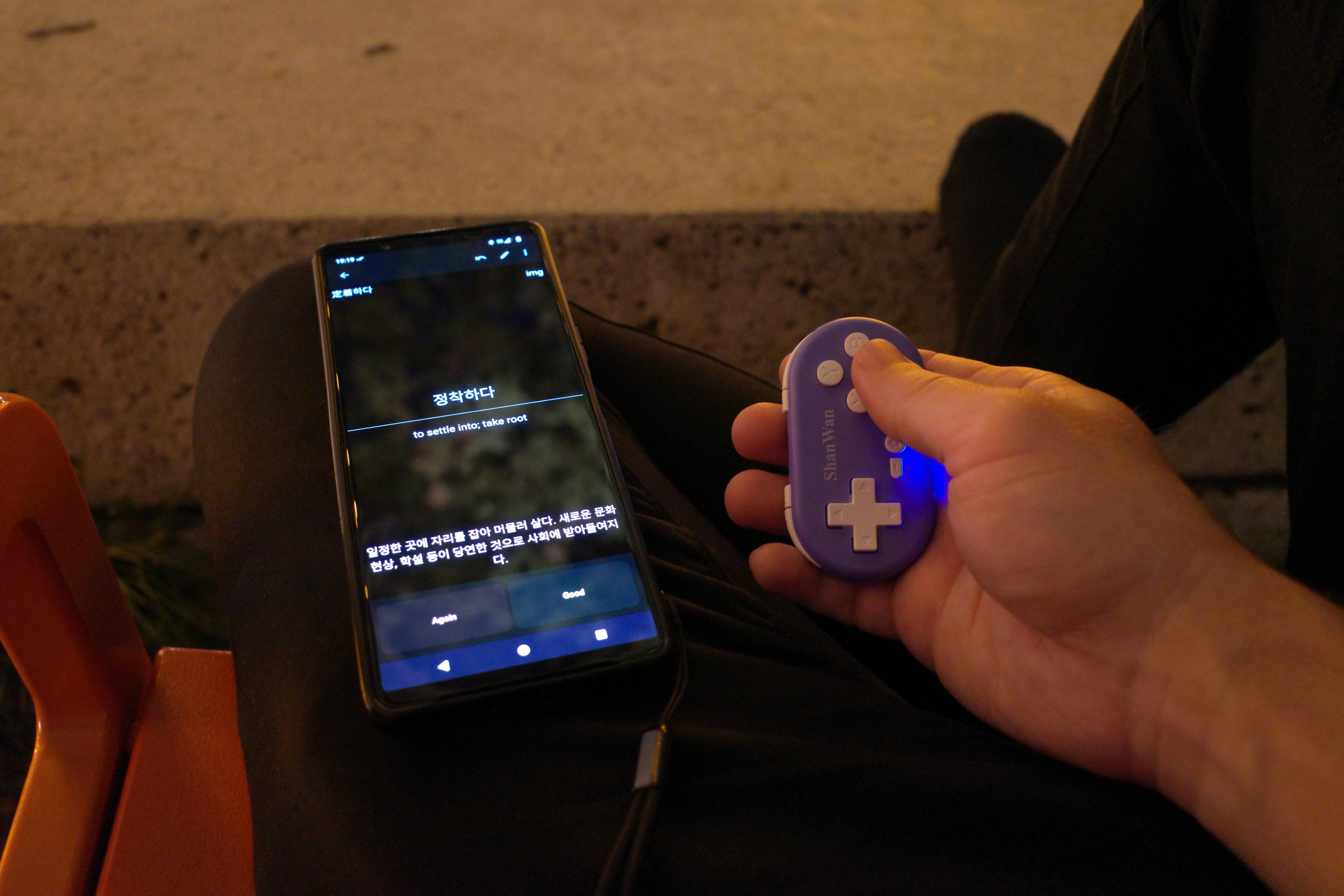
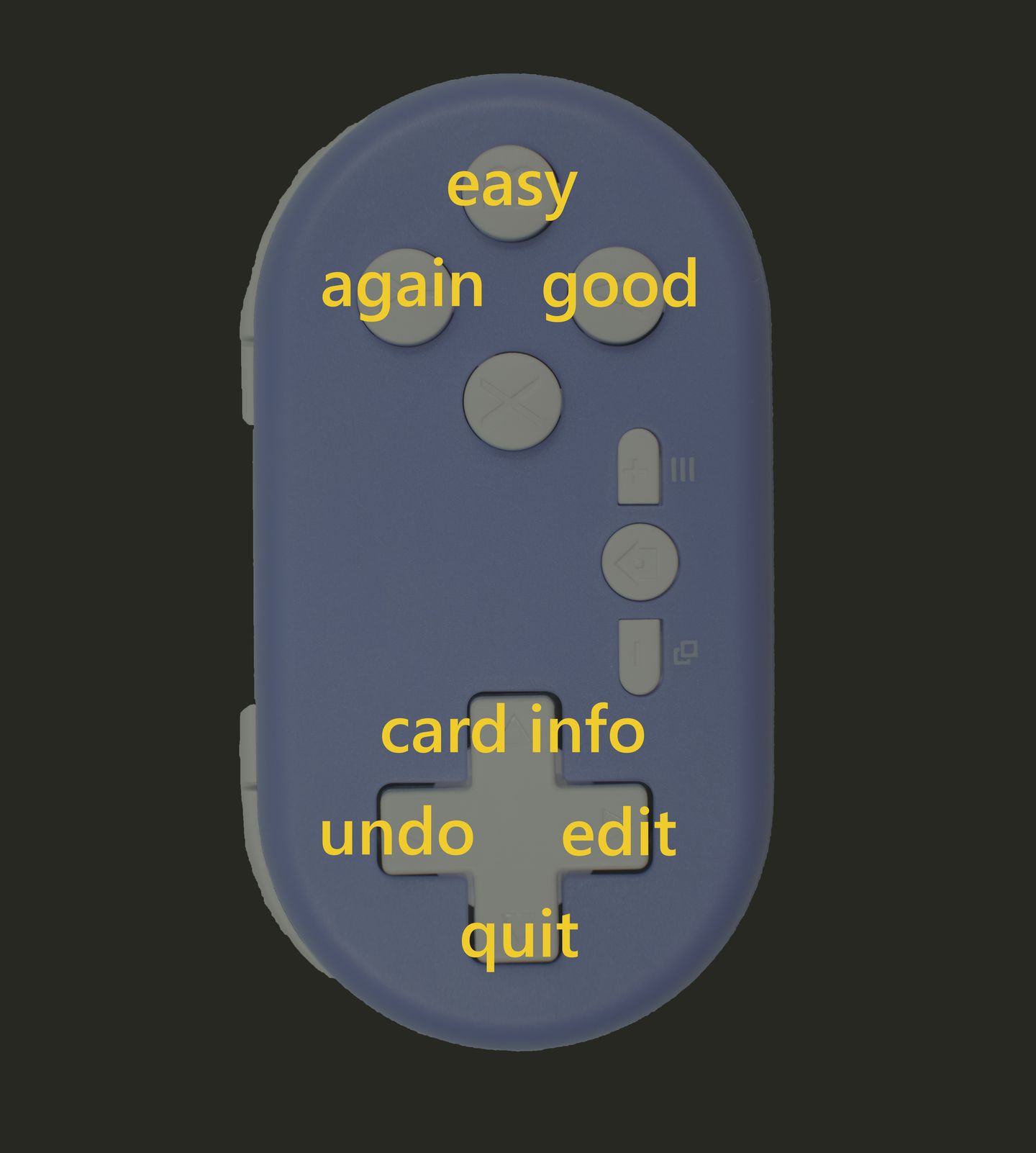
I do 99.9% of my Anki on my phone with AnkiDroid, including the adding and editing of cards. Even when I am at home, I would mostly rather use my phone for Anki than my computer, which is funny since for almost everything else in my life it would be the opposite. The posture of sitting at the keyboard is not a pleasant way to study, for me. I have long since disassembled the ankibutton, but I've just recently bought a bluetooth controller and am enjoying it very much.
My Anki notes contain these fields:
| Anki field | remark |
|---|---|
| Korean | Most of my notes are just a single word, but this is also sometimes a phrase or grammar pattern. |
| English | Sometimes a single word, usually several possible synonyms or nuance. |
| Hanja | If applicable. |
| KDef | Korean definition from the dictionary. |
| Sentence | Sometimes I'll copy one of the example sentences from the dictionary, or the original sentence where I heard the word. Oftentimes I'll leave this blank as I actually don't think it's critically important. |
| Pronunciation | This is usually blank, but sometimes a reminder helps. For example, 솜이불 is pronounced [솜:니불]; 들일 is pronounced [들:릴]; 막일 is pronounced [망닐]. |
| Hint | To disambiguate homonyms, I need to give myself a hint. Most of the time, this is just the first letter of the English word. 다리 (l...) = leg 다리 (b...) = bridge 바르다 (to a...) = to apply; spread; put on; fill in 바르다 (to b...) = to be straight; upright; correct; righteous |
I have been adding the hanja to my notes since the very beginning and I am glad that I have. I absolutely recommend you do the same. This makes it so much easier to search your collection for other words with the same hanja and therefore build a deeper understanding and connection to the vocabulary. Hey, 전차 has the same 전 from 전쟁. Literally, a war car!
I did not store the Korean dictionary definition in my notes until recently, and I wish that I had. I have not yet made the so-called monolingual transition of looking up words exclusively in the Korean dictionary and understanding their definitions that way. I hope that by capturing the KDef now, I can prepare to eventually do cards that are Korean→KDef, and anyways for the time being to engage with the Korean definitions moreso than I have in the past.
If/when I do switch to monolingual K→KDef cards, I'll have to be judicious with which of these notes become cards. Even if I've added the KDef for a word like "apple" as a way of helping me get familiar with how a dictionary defines an object or expresses an idea, I don't actually need that definition to help me understand what an apple is. There are going to be lots and lots of words for which the K→E cards are perfectly sufficient.
Almost all of my cards are just a single Korean word on the front and the English translations on the back. Sometimes I'll have a single verb as its own one-word card, and also as part of a set phrase card, because set phrases basically need to be memorized as independent vocabulary. For example, 간지럽다 = to be itchy, and 입이 간지렵다 = to be dying to say something (mouth is itching).
I know that some people encourage using mostly sentence cards. Once I get to the point that I am no longer encountering very many new single words, I may shift into a higher gear and start adding more and longer phrases as cards. I think this framing of "gears" is reasonable, since at the beginning you need to memorize the alphabet, then you need to practice reading syllables, then you practice words, then you practice phrases and idioms.
At my current skill level, I find that sentence cards or even phrase cards make it too easy to memorize the shape of the card and remember the answer before even reading the main key word in the sentence. For example, I can recognize "가슴이 덜컥 내려앉다" simply because I know it is the only card I have that starts with 가슴이, even if I completely ignore the rest of it. However, once there are several hundred sentence/phrase cards in the system, they will probably stand out less and less in this manner.
I added the Sentence field recently, at the same time that I added KDef. Although I fill in the KDef for all new words that I add now, I don't always add a sentence. For a lot of words, I think a sentence does not help me internalize the meaning moreso than the definition alone. The problem with vocabulary is that there's so much of it, but not usually that it's actually hard to understand. I do add a sentence if the word seems non-obvious to put into usage, or if it helps demonstrate an interaction between this word and another verb, or if it just seems interesting. If there's a particular usage or set phrase that I want to learn, I would just add it as its own card in the main field, rather than as the Sentence field of this word card.
I do not use audio or images on my cards.
From time to time I like to enable the whiteboard mode on Anki so that I can practice writing words. I do think this has helped with my ability to handwrite, but it does not otherwise lead to higher retention of the words for me. It winds up just being a slower way to review, and I think handwriting practice is maybe better done as a separate activity if the goal is handwriting improvement.
From the very beginning in 2018 until my recent restart, I had always had my Anki set to generate both Korean→English cards and also English→Korean cards. In language learning, these are referred to as Recognition (can you recognize the Korean word when you are reading/listening) and Production (can you produce the Korean word when you are writing/speaking).
I had both cards generating from the same Note. This, I have realized, was a mistake. I have now deleted the production cards and I am only doing recognition at the moment.
Production cards themselves are not the problem. The problem is using a single note to generate both the recognition and production cards. The root of this problem is synonyms. When reading a single Korean word on the front, there are usually several English words on the back in order to capture the nuance, connotations, and possible usages of the Korean word. This means that when generating a production card from this note, I'd have multiple English words on the front asking me to remember a single Korean word. But this is pointless, because of course there could be several Korean synonyms to pick from.
Given these notes:
- 맞다 = to be right; correct; be a good fit
- 옳다 = to be right; correct; righteous; better
- 바르다 = to be straight; upright; correct; righteous
You can see that using these notes to generate English→Korean production cards, having multiple English words on the front and only only one Korean answer on the back, is futile. Which is what I was doing.
During the time that I was doing this, I would add an E→K hint (this was another field, which I have since deleted) to disambiguate which of the Korean words was the right answer. But this becomes increasingly convoluted when both Korean words start with the same letter (oftentimes because they derive from the same hanja), and then when the second letter is also the same, and then when they have the same length, etc.
- firewood (ㅈ) = 장작
- firewood (ㄱ) = 군불
- firewood (ㄸ,2) = 땔감
- firewood (ㄸ,3) = 땔나무
If you want to add production cards to your study, you really need to make them as a whole separate note. Maybe it would be something like:
- to be right = 맞다; 바르다; 옳다
- to be correct = 맞다; 바르다; 옳다
- firewood = 장작; 군불; 땔감; 땔나무
Besides the synonym problem, there is another serious problem with generating both recognition and production from a single note: It is absolutely, completely normal for your passive vocabulary to be much larger than your active vocabulary, even in your native language. That means you can understand more words when you read or listen than you personally use when you write or speak. The ratio of your passive:active vocabulary in your native language is probably between 3:1 and 5:1 based on some quick internet searches. By generating both cards out of a single note, this creates a 1:1 study workload for recognition and production, which is fundamentally out of line with the reality of vocabulary. Plus, those production cards get failed more often because production is harder and because the cards themselves were flawed to begin with. Make separate notes.
At the moment, I am not making separate production notes, though. I want to finish working through all of my existing cards, get more listening and reading input, and see what comes out.
For most of this time, I tried to organize my newly added cards into subdecks. So my primary Anki deck is called "ㅎ", and within that I added ㅎ1, ㅎ2, ㅎ3. When you click on the main ㅎ to study, Anki will draw cards from all subdecks for review. And when you finish reviews and move into new cards, it would draw from ㅎ1 before ㅎ2, etc. So, when I was adding new words, I would use ㅎ1 for high priority words that I want to enter rotation soon, ㅎ3 for low priority words that I will not need for a long time, and ㅎ2 as the standard option. For whatever reasons, my experience with this was never quite perfect. When I would accidentally place cards in the wrong deck I would have to go fish them out again, and sometimes my card browser would browse ㅎ2 when I wanted it to search all ㅎ and I would not be seeing the results I expected. I don't know, I won't criticize it too much but it just never felt like an extension of me.
In my current phase of cramming vocabulary, I have dropped the subdecks and merged everything into ㅎ. I'm going to have all these cards in rotation within a few months, so there's no more splitting hairs about priority.
If I add a word and I want that card to be in rotation right away, I'll use the "grade now" button in AnkiDroid's card browser to mark it Again. If I add words that I know I don't need — such as, say, the majority of the periodic table of elements — I'll suspend them so that I can keep them around as a dictionary but not waste time memorizing them. So that is now the method of coarsely setting priority levels.
I just created a new page on my website which holds iframes to the different dictionaries (K→E, K→K, Hanja) as well as an image search and translator. This is useful because sometimes I want to try reading the K→K dictionary first, but fall back to the K→E dictionary if I need some help, and sometimes a word is in one dictionary but not the other, and of course it helps to have an image search to provide visual aid. So this all-in-one page saves me from having to open multiple tabs or go back and forth between links.
https://voussoir.net/koreaniframe
It would be neat if, instead of just iframing these pages, I would fully proxy the search and manipulate / minify the HTML to provide a more perfect interface. But I do not want to have to keep up with anything they might change along the way.
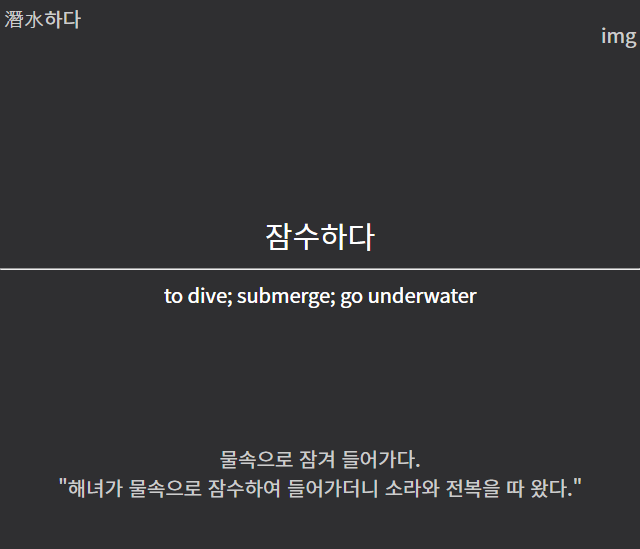
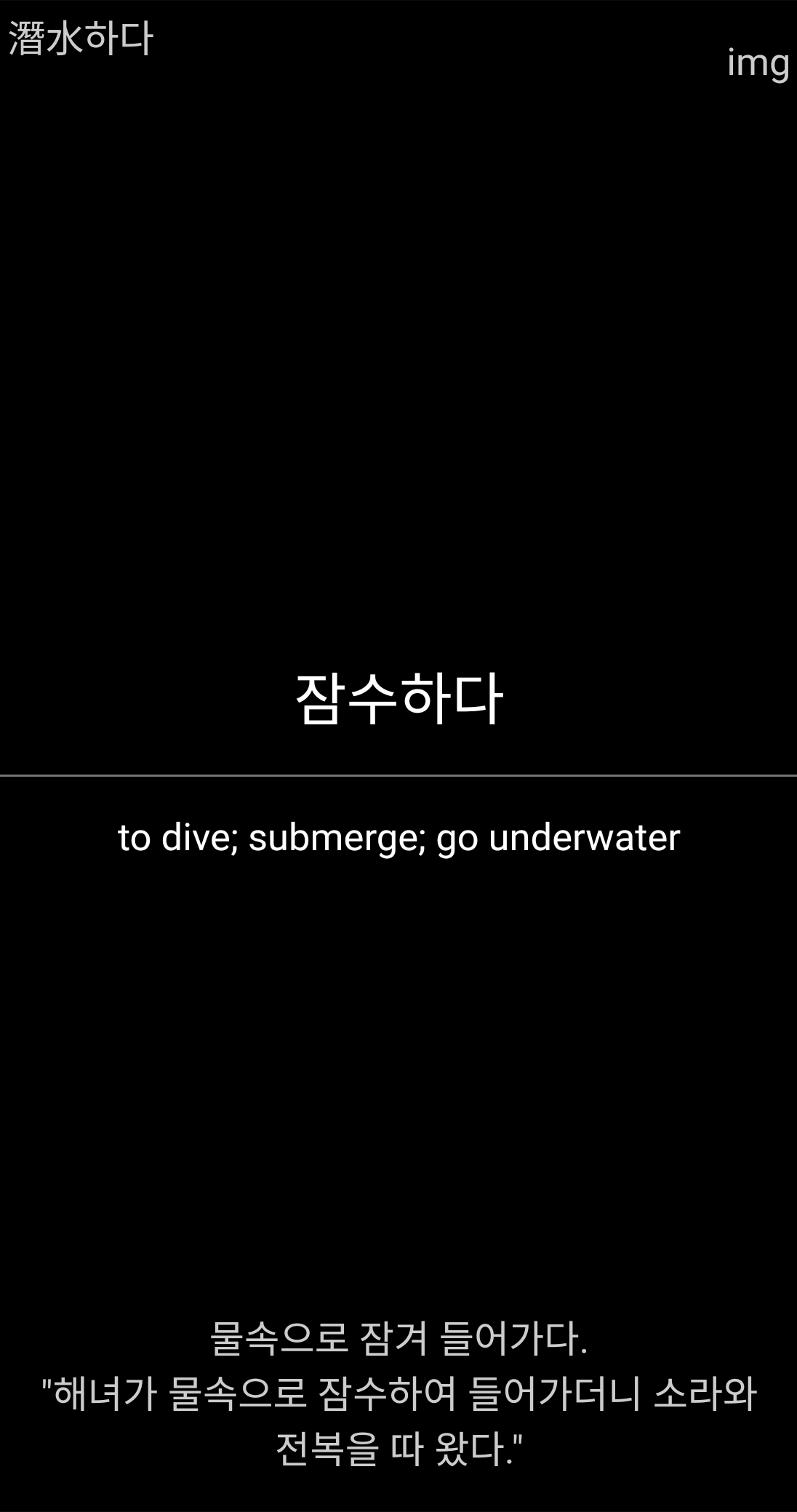
On my card template, the word itself is a clickable link to my iframe page. Up in the corners, I have links to Naver images (because their site wouldn't work with the iframes) and the word's hanja. At the bottom I have the KDef and sentence.
Here is my card template:
Front:
<div class="frontface" lang="ko"><a href="https://voussoir.net/koreaniframe?q={{Korean}}">{{Korean}}</a>{{#Hint}} (<span class="hint">{{Hint}}</span>){{/Hint}}</div>

<div id="otherlinks">
<!--<a id="endictlink" href="https://korean.dict.naver.com/koendict/#/search?query={{Korean}}">dict</a>-->
<!--<a id="kodictlink" href="https://ko.dict.naver.com/#/search?query={{Korean}}">사전</a>-->
<a id="imglink" href="https://m.search.
naver.com/search.naver?where=m_image&query={{Korean}}">img</a>
<!--<a id="voussoirlink" href="https://voussoir.net/koreaniframe?q={{Korean}}">사전</a>-->
</div>
Back:
{{FrontSide}}

<hr>

<div class="backface">
<div lang="en">{{English}}</div>
{{#Pronunciation}}<div lang="ko">[{{Pronunciation}}]</div>{{/Pronunciation}}

<div lang="ko" id="hanja" data-hanja="{{Hanja}}"><a href="https://hanja.dict.naver.com/search/?mflag=1&query={{Hanja}}">{{Hanja}}</a>
</div>

<div id="bottomstuff" lang="ko">
{{#KDef}}<div>{{KDef}}<div>{{/KDef}}
{{#Sentence}}<div>"{{Sentence}}"<div>{{/Sentence}}
</div>

</div>
Styling:
*
{ xoutline: 1px solid red; }

*
{ font-family: "Noto Sans KR Regular", "Noto Sans", "Noto", "Arial", "sans serif"; }

html
{ overflow: hidden; }

body
{
    position: absolute;
    bottom: 0; right: 0; left: 0; top: 0;
    margin: 0;
    padding: 0;
}

.card
{
    font-size: 20px;
    position: absolute;
    bottom: 0; right: 0; left: 0; top: 0;
    display: grid;
    align-items: center;
    text-align: center;
    user-select: none;
}

.frontface
{
    font-size: 1.5em;
}
.frontface,
.backface
{
    max-width: 95%;
    margin: auto;
}

a
{
    position: relative;
    color: inherit;
    text-decoration: none;
}

#hanja
{
    position: absolute;
    top: 4px;
    left: 4px;
    font-size: 1em;
    color: #ccc;
}
#hanja[data-hanja="-"]
{
    display: none;
}

#otherlinks
{
    position: absolute;
    top: 20px; right: 4px;
    display:flex;
    flex-direction: column;
    color: #ccc;
}

#bottomstuff
{
    position: absolute;
    bottom: 1em; left: 5%; right: 5%;
    display:flex;
    flex-direction: column;
    justify-content: end;
    color: #ccc;
}
Language exchange groups (§)
I have been going to two different language exchange groups (한영 언어 교환 모임). Every other Wednesday I am at the OC Source mall in Buena Park, and every Thursday I am in Irvine.
Attending these meetups has been extremely helpful and I am grateful to the organizers. The main thing is these groups have helped me build the courage to actually speak. The first time I arrived it was completely nervewracking to say anything at all. I actually said oui at one point in my frazzled state. Everyone there tells me I'm doing pretty good.
In June, I visited K-Town LA to see if I could find any interesting spots. I wandered the streets for five hours and didn't strike up any conversations with anyone, and I spent most of my time regretting that I had answered the shop attendant at Kim's Home Center in English rather than Korean. I left town feeling pretty lousy for a number of reasons besides that.
Earlier this week, I went out for a walk in my neighborhood, and suddenly I heard a familiar sound behind me. Another gentleman was walking in the same direction as I was, listening to something on his phone. I stopped until he was a little closer, then, 안녕하세요, and we talked for several minutes about me learning Korean, him learning English, and his daughter trying to learn Korean as well. This conversation was maybe only 20-30% Korean and the rest English, but that's really good compared to where I was a few months ago. The confidence to even try talking to a stranger is exclusively thanks to spending time at the meetups. He lives around the corner from me and we exchanged phone numbers.
I have also realized how fortunate I am to live next to multiple large bubbles of Korean demographic. I imagine that if I were learning Korean while living in a different state, I would have a hard time finding people to practice with. But I'm within an hour of K-Town LA, Buena Park, Pasadena, Irvine, and broadly speaking the LA and Orange counties have large Asian populations. This is something I didn't properly appreciate when I was thinking "I shouldn't go to any meetups because I'm not ready to speak yet".
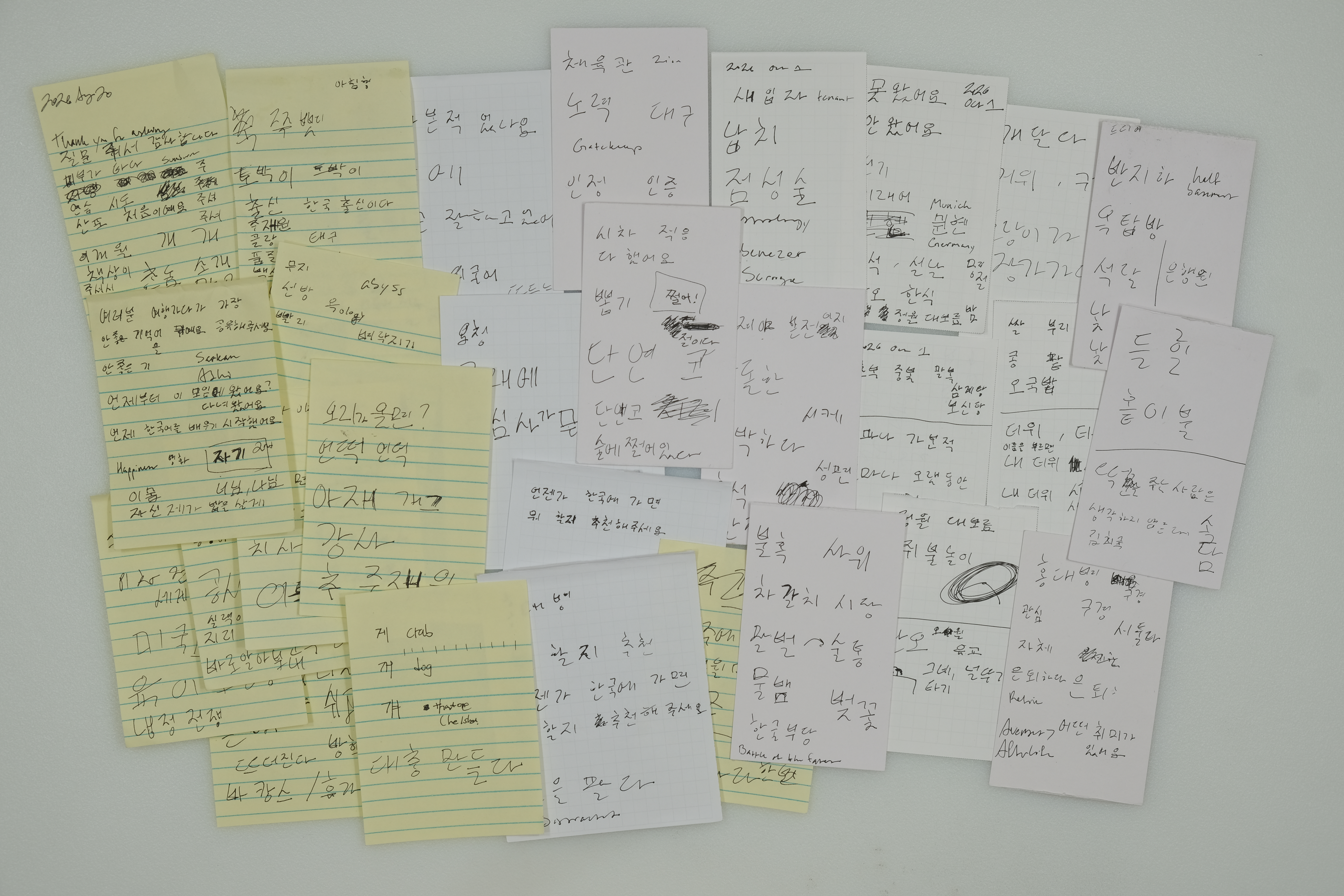
I always come home with notecards and new words that I should add to my Anki when I have some time.
There have been some days at the meetups where the conversation is largely dominated by a particularly talkative person with a particularly low Korean level — sometimes I mean not even knowing the famously-easy-to-learn alphabet — who spends the entire time talking in English. I'm not referring to one specific person, this is an archetype that I've seen a few times. Usually, the rest of the group is very excited to teach this person the basic yes/no/please/thank you, and then I am sitting there not learning anything for the better part of hour. Those days are frustrating to me. I would be 100% more fine with this if they wanted to just sit and listen, which is what I do when two native speakers are having a conversation at my table. Why would I interrupt free in-person native listening practice to ask an ignorant question in English? Of course I'll stay silent. This practice harkens back to an ancient tradition from my culture called "lurk more".
There are other days where the tide shifts, and I am at a table outnumbered by 원어민 and I can't keep up with what they're saying. So, I don't mean to be insulting, but to describe my feelings because that's the whole point of this website; and to say that if you try a meetup and it doesn't seem to be quite what you were looking for, you probably should keep going for a while to see what happens on a different day.
Based on my positive experiences so far, and the fact that these groups are still relatively far from home for me, I have been trying to muster the inspiration and courage to start a group, too. I think the population is here and they simply need a catalyst. I'll invite my neighbor.
So this is how they get me (§)
During the past several years' boom of so-called AI and more-aptly-called LLMs, I have completely avoided using them, mainly because they are surrounded by so much bad marketing that I don't want to endorse, and because I like to go against the mainstream.
But... they're pretty good for asking language questions. So that's how they've got me after all.
I saw one of the guys at language exchange asking the computer to provide expressions using a word or grammar pattern, translate the answer between both languages, and rephrase a given sentence into a more natural / idiomatic form or other variations. So, I'm sold on it after all. I gave mine the instruction to never use romanizations (which makes the answer so much more pleasant to read, even if the information is just coming from Wikipedia), to provide the relevant hanja for advanced vocabulary, and to not do any of that "you're absolutely right!" type stuff. I have caught the computer making factual errors more than a few times, so you probably shouldn't ask questions that are too high above your ability to comprehend the answer.
Give it a try, I guess.
Navel gazing (§)
People often wonder how many words an average adult knows in their native language. They also wonder, more anxiously, what is a reasonable minimum number of words to be conversationally fluent in a new language. These are interesting trivia in their own right, of course, but the true combinatorial explosion of fluent language is in phrases, expressions, and idiomatic speech. It is not enough to use grammatically correct verb conjugations to sound normal. At language exchange, all of the English learners I've met are out of the basic vocabulary/grammar phase; they're learning expressions. 표현.
With such an infinity of examples available, it is hard to pick a representative few to write about here. But take for example "put down", which can mean literally placing an object somewhere, or insulting/mocking someone, or euthanizing an animal, or writing into a form/document, or making a down payment on a purchase, or making a bet at the poker table, or... Even though each of these figurative meanings is pretty easy to trace back to the literal meaning, they still take on a value of their own. I know for sure that my flashcards for verbs do not capture this much nuance.
Then you have expressions like "all bark and no bite", the meaning of which seems not too hard to intuit, but it's a set phrase you wouldn't just make up one day. You must hear it from someone else first. How about "all hat and no cattle", which is similar in meaning but evokes the cultural context of cowboys and surely must be regional in usage. I have not reached the level of learning many Korean 표현 quite yet, and certainly not with that level of integrated social context. Maybe the best 표현 I can give you so far is "빈 수레가 요란하다".
It is overwhelming to think of how much cumulative experience with phrases, idioms, and movie/song/cultural references there is in one's life. There is too much that you just won't find in a dictionary, and I don't just mean that euphemistically. You have a limited number of hours in the day, and every hour you spend ingesting one form of input is an hour that you are not ingesting another. I should think it impossible to fully "catch up" in a second language, and the goalposts when learning a language must be set with this understood. For what it's worth, this is not even a language phenomenon at all, really, because it's the same for your career and hobbies and community subcultures — you can only be in one place at a time.
But, there are pages full of idioms if you want to go ahead and learn some out of context:
https://en.wikipedia.org/wiki/Category:English-language_idioms
https://en.wiktionary.org/wiki/Category:Korean_idioms
I find that people are too fascinated with little differences between languages that aren't actually different. Almost more than anything else, attempting to learn a second language will show you that people are pretty much the same everywhere. Everyone talks about the same stuff — it's just different words. I suppose I'm not allowed to make such universal claims when I barely know one and a quarter languages, but.
Take for example the concept of honorifics. Most monolingual English speakers, or at least Americans, probably don't know this word, but as soon as you step into Japanese, Korean, etc., everybody's talking about honorifics, not to mention speech levels in general. How foreign! How Asian! How tradition! But if you've ever seen a movie with a stereotypical English butler character, then you know very well that English has honorifics, and you know exactly what they sound like, and you can reproduce them on command. Even if you didn't know the word for it. Everyone around the world has ways to talk respectfully; in English we just do it with diction and register rather than grammar and morphology.
When people talk about the differences between two languages, I often think of this XKCD comic where he describes "sleep" as "go comatose for a few hours, hallucinate vividly, and then maybe suffer amnesia about the whole experience". You can make anything sound weird by putting more words to it. So I think what happens is people seek explanations for how their target language works, and they put a whole lot of words into these explanations, and it psyches them out into thinking that the target language is so crazy different from their native language, only because they've never put so many words into explaining their native language.
People often say that Korean and English are "backward" because English uses SVO and Korean uses SOV word order. In Korean, it's "I pizza eat". 나는 피자를 먹는다. I feel that for basic sentences, the difference is quite trivial and really does not come across as weird at all, after a moment. It's kind of like when you watch a black and white movie, and it barely takes a minute to get used to it despite, superficially, the huge difference between black and white film and our own color vision.
The larger and more daunting task is the ordering of entire phrases. It is not just a grammatical problem — thinking about this has made me even more aware and self-conscious of sentence- and conversation-level ordering of information. Depending on how you deliver an opinion, story, or question, you can prime the listener's understanding of your context, intentions, and emotional state, and convey the relative importance of each part. And crucially, you can hit them with a joke. We often start sentences with a disclaimer like "I know this is going to sound weird, but..." because we anticipate how people will react to what we're going to say and we try to deliver it appropriately.
Especially in speech, being strictly linear, the order of your words slowly reveals your thought to the listener, and you have to appreciate your level of control over that reveal, like a magician. When I am trying to construct a Korean sentence, I find myself thinking "wait, I don't want to say that word yet, I want to save that for later", but I can't because it's supposed to come first.
I have been particularly aware of the differences in "importance" ordering when I am reading definitions in the dictionary. I'm not sure if I'll find the best examples now, but here's a few:
계기
길이, 면적, 무게, 양 등이나 온도, 시간, 강도 등을 재는 기구나 장치.
literally: "length, area, weight, quantity etc. or temperature, time, force etc. measuring tool or device"
Compare with English:
meter
an instrument for measuring, especially one that automatically measures and records the quantity of something, as of gas, water, miles, or time, when it is activated.
In English, you get "an instrument" within two words, and to clarify it's not for music, you get "measuring" within four. Whereas in Korean you don't even find out that it's a noun until the very end (context clues notwithstanding).
Another:
단열재
열이 밖으로 빠져나가거나 안으로 들어오는 것을 막는 데 쓰이는 건축용 재료.
literally: "(heat) (going out or coming in) (used to block) (construction material)"
thermal insulation
material of relatively low heat conductivity used to shield a volume against loss or entrance of heat by radiation, convection, or conduction
To me, the Korean ordering seems backward, not because of the VO/OV difference between "blocks heat" and "heat blocks", but because it seems more prudent for me to start a definition of an object with what it basically is, then clarify with further detail. If someone asks me what "thermal insulation" is, I'd lead with the fact that it's a material, then describe properties of that material. It seems more ... respectful? ... to the listener's attention to order it that way? The Korean dictionary describes all the properties first, and then the word 재료/material is literally last. This is the difference that must be learned.
Yes, I've been watching some English linguistics videos recently, too.
People also like to notice how Korean often omits subjects or objects that can be inferred. For example:
밥 먹었어요?
Eaten food?예, 먹었어요.
Yes, eaten.
Yes, it sounds weird when it's translated so literally that way. But this is just another case of "hallucinating vividly", where you can make anything sound weird if you do it on purpose. In English, we'd say "have you eaten?" and "yes, I have". Have what? The actual verb for the past tense auxilliary "have" is omitted in the English response, because it's obvious. So the subject is often omitted in Korean when it's obvious, too, even though Korean may choose to preserve the original verb where English drops it.
Here's an example of how omitted subject can be used humorously:
경은: 효진 씨, 친구들 자주 만나요?
Hyojin, do you get together with your friends often?효진: 자주 못 만나요, 바빠서.
Not too often, busy.경은: 아, 바빠서. 효진 씨가 바빠서요? 아니면 친구들이 바빠서요?
Ah, busy. You're busy? Or your friends are busy?효진: 친구들이 바빠서...
My friends are busy...
You've noticed by now the way I talk about "other people being too fascinated by ..." as if they should be embarrassed for being fascinated by something. What a jerk! Do I actually believe that? On one hand, yes. There is a lot of thing, Japan that goes on out there, and a lot of "In Japan, they have an ancient tradition..." about something mundane, and a lot of "hallucinating vividly" to make the foreign language sound more exotic than our native language. People get tattoos on their spines of hanzi/kanji meaning "love" or "strength" that they don't actually know how to read because hell if hanzi don't look way cooler than our alphabet.
I go to the international market, buy some Korean candy for three times the price I'd normally pay for candy, and then, yep, it's just candy. We seek to buy products that come from our country of interest even if they are not actually different or better simply because they carry the aura we want to carry. This behavior smells desperate, insecure, uncritical. When I go to events like the 626 Night Market or, yesterday, the LA Korean Festival, I am disappointed by how many of the stalls are just selling ordinary plastic, consumerist, intellectual-property-laden crap, and by the 화채 stalls advertising "AS SEEN ON TIKTOK". I will once again direct you to Ghost Dog for more on this.
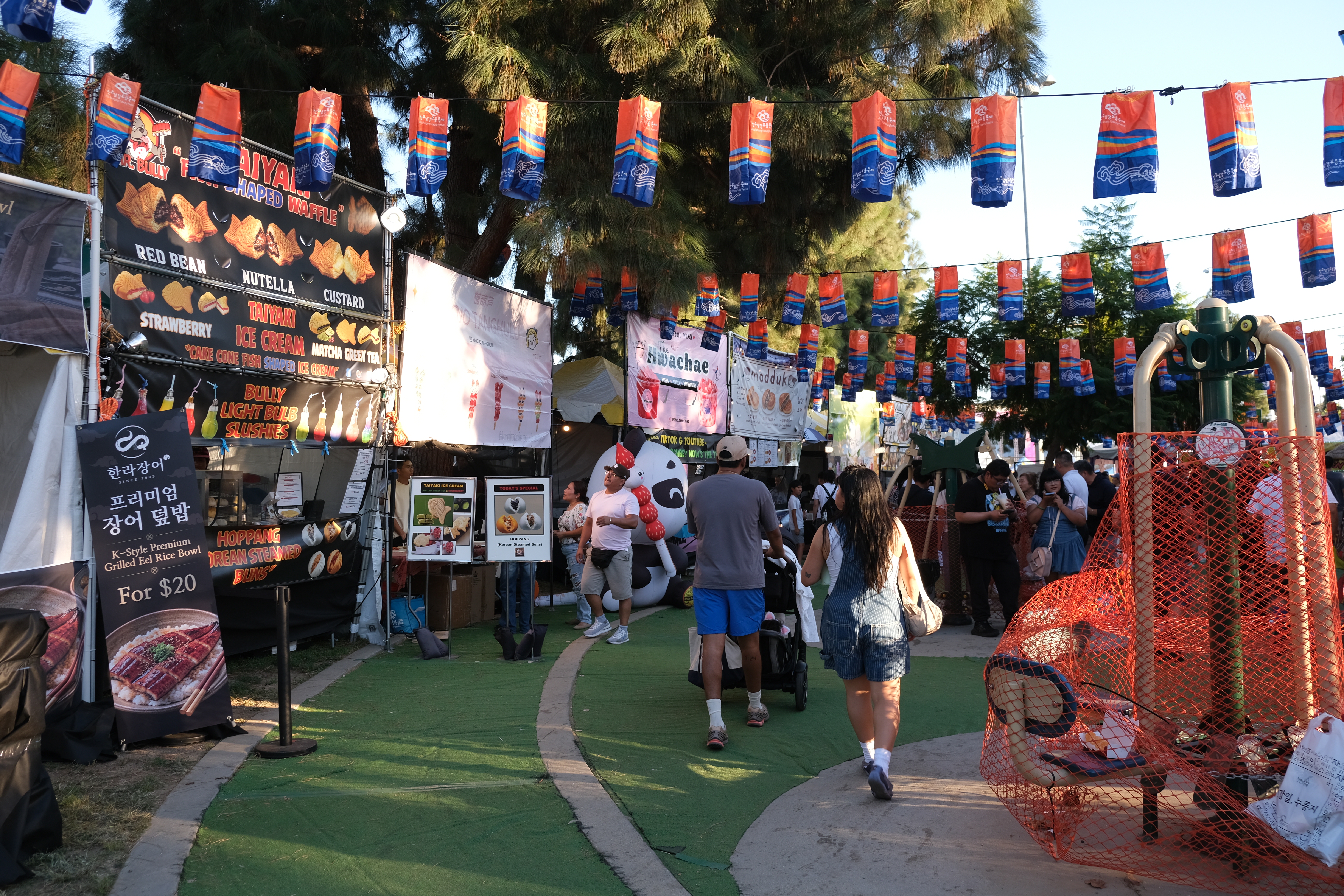
(nota bene: The LAKF had a long corridor of stalls selling food products that came across as very authentic to me, with lots of handwritten prices and many clearly handmade goods. Those were the vendors you'd have to speak Korean to if you needed to ask anything.)
On the other hand, no, I don't like this negativity either. I have made the mistake once or twice of stopping by /r/languagelearningjerk, a wonderfully egalitarian community in which everyone is treated as a complete loser. Here, anything you think is interesting is actually not interesting; anything you think is fun is actually not fun; and your motivations for doing absolutely anything are absolutely wrong. A visit here is a complete and total drenching in self-doubt.
Clearly I have standards, maybe high standards, for tasteful appreciation of other culture. But it is not fun to be constantly questioning myself as to whether I think such-and-such is beautiful because I actually think it's beautiful, or because I'm a basic normie falling for the exoticism trap. There is not a single person in my life asking me to justify any of this, except myself.
People say that there are some 7,000+ languages spoken in the world, which, for reasons that are hard to articulate, genuinely stresses me out when I try to think about it. One of my reasons for choosing Korean is because I want to be different from all the people learning Japanese. So I basically took one step down the trendy-language ladder, a ladder with 7,000+ rungs, and I pretend that's even a little bit out of the mainstream?
When I once told someone at language exchange that I want to be different, she taught me the word 홍대병, basically "hipster disease", which is perfect for me.
Artifacting (§)
I don't want to be a complete -boo per se, but I wanted to get a few decorations at home of an Asian aesthetic. Yes. Sorry for the whiplash.
I became interested in the 훈민정음 (wikisource), the document that introduced the new 한글 alphabet to the public. I ordered a large 24x32 canvas print of the first page.
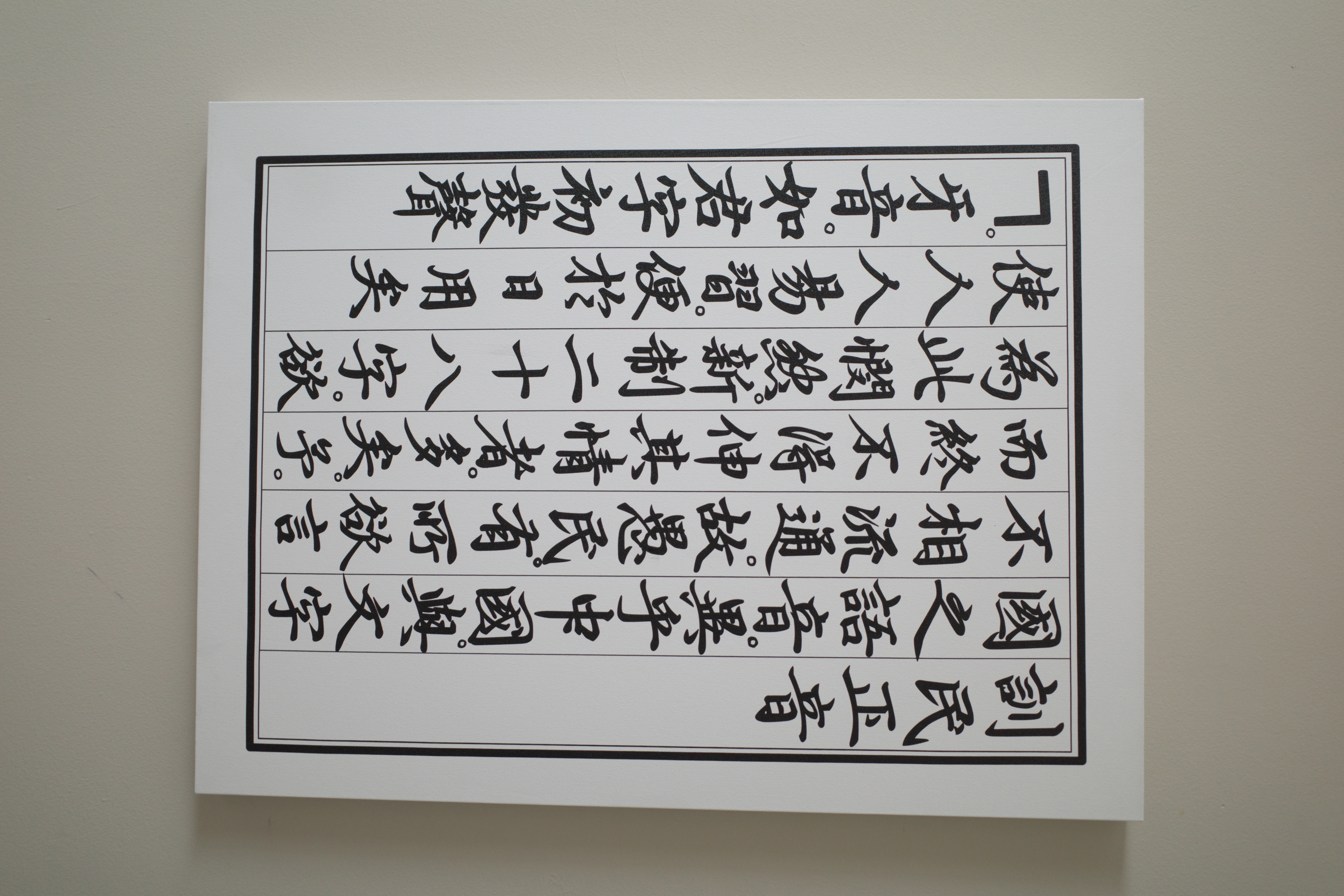
I produced the vector file for this by taking the best photograph/scan I could find online into Inkscape and, over the course of several evenings, tracing each character by hand.
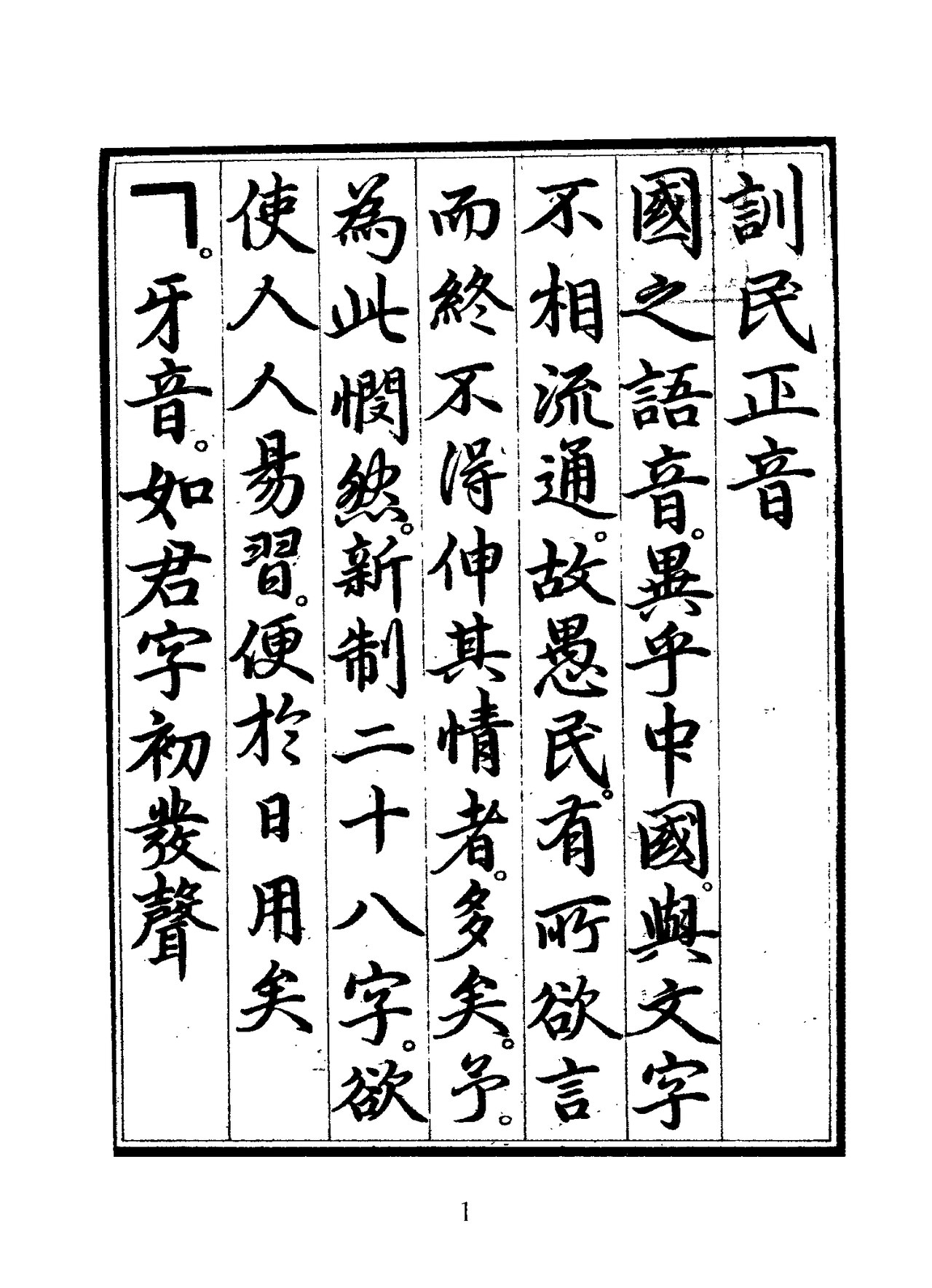
Here you go:
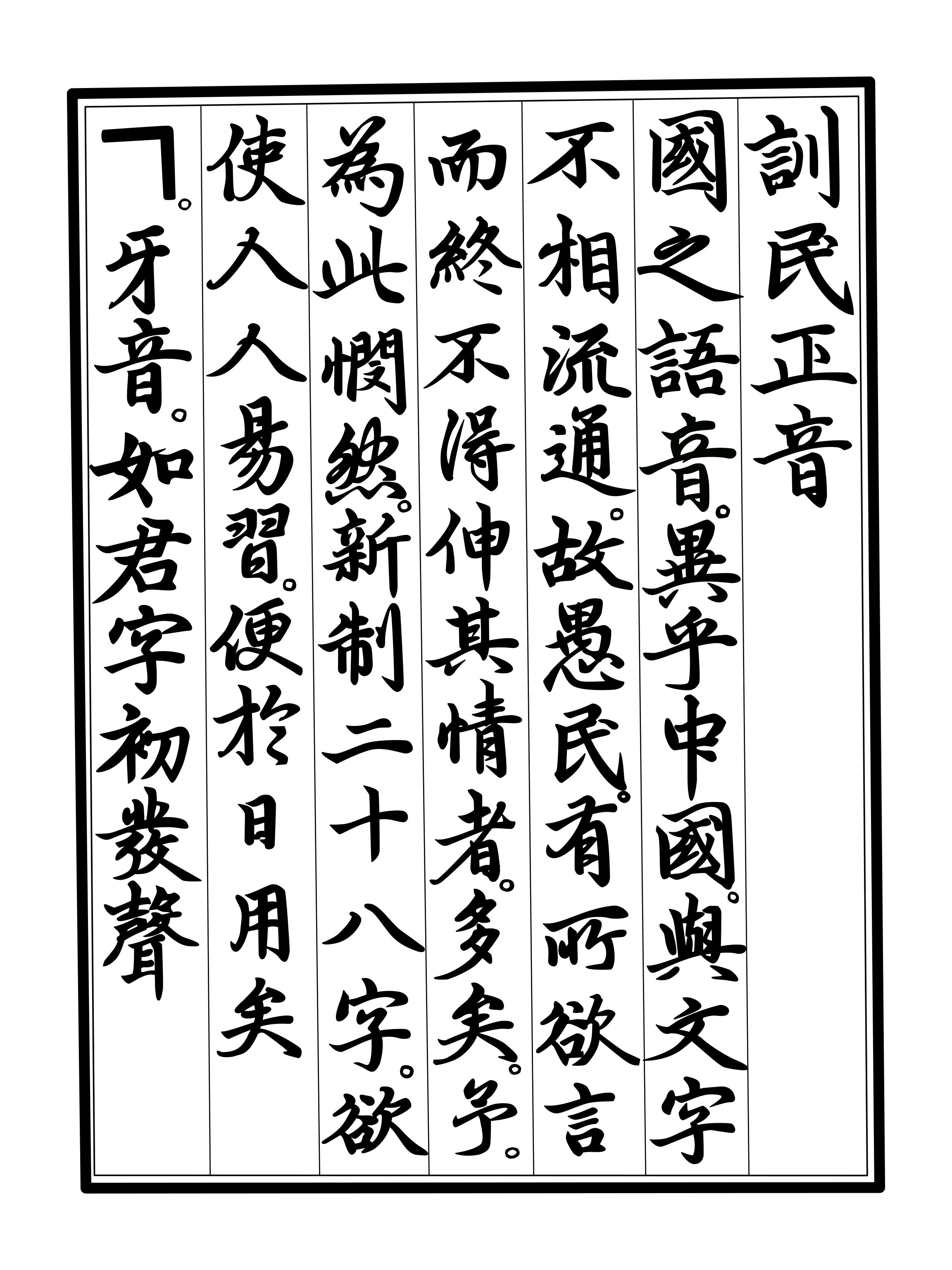
I'm too busy getting this tattooed on my spine, so I don't have time to memorize the Chinese reading of this text, but working on this project has helped me get a little more familiar with a few more hanja — I won't miss 音 in a lineup, at least. I can point to some of the landmarks and paraphrase it, if need be.
I also bought one pack of Japanese 花札 cards and two packs of Korean 화투 cards with the intention of turning these into framed pieces of wall art, like as tall 4x12 grids. But I haven't gotten around to it yet.
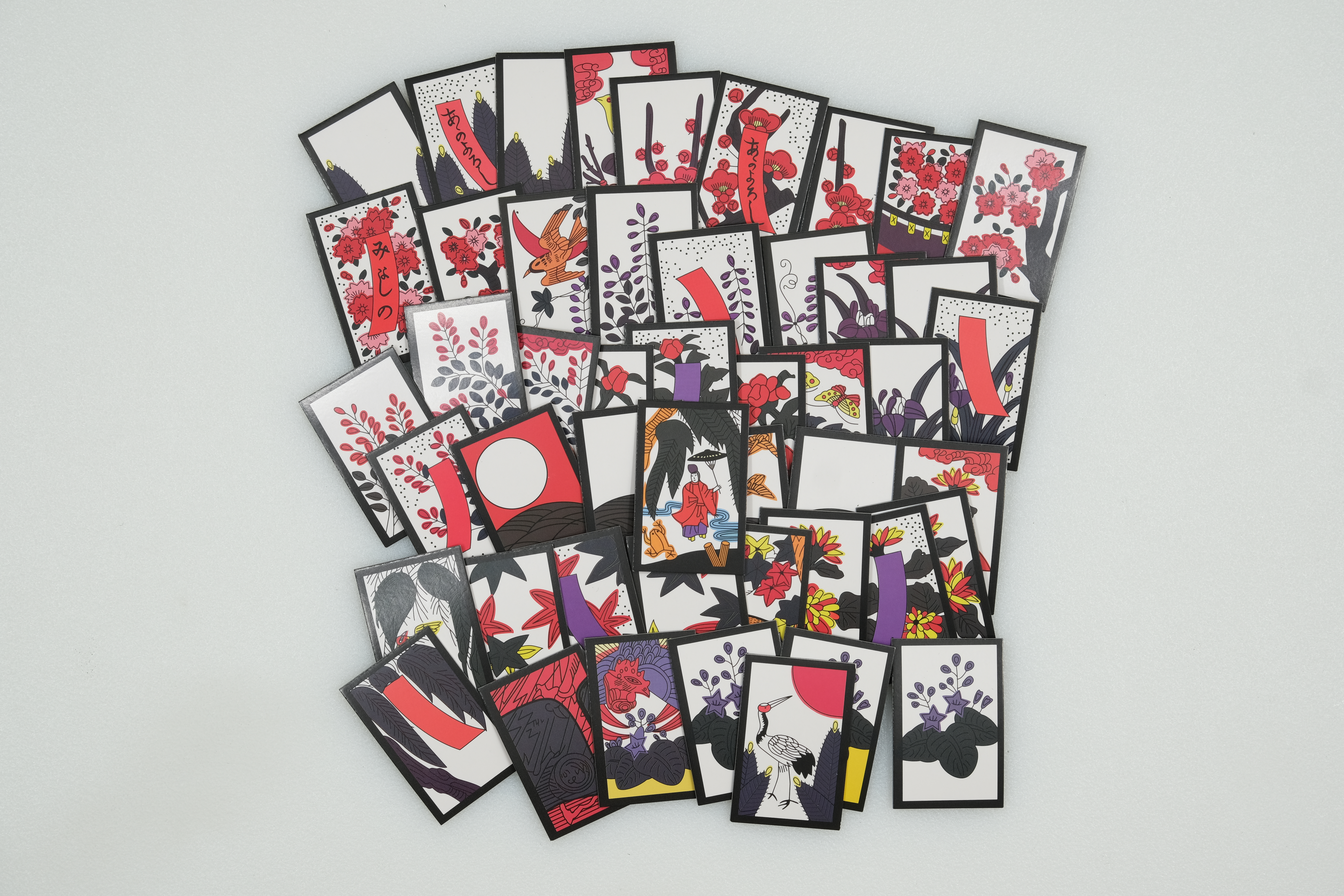
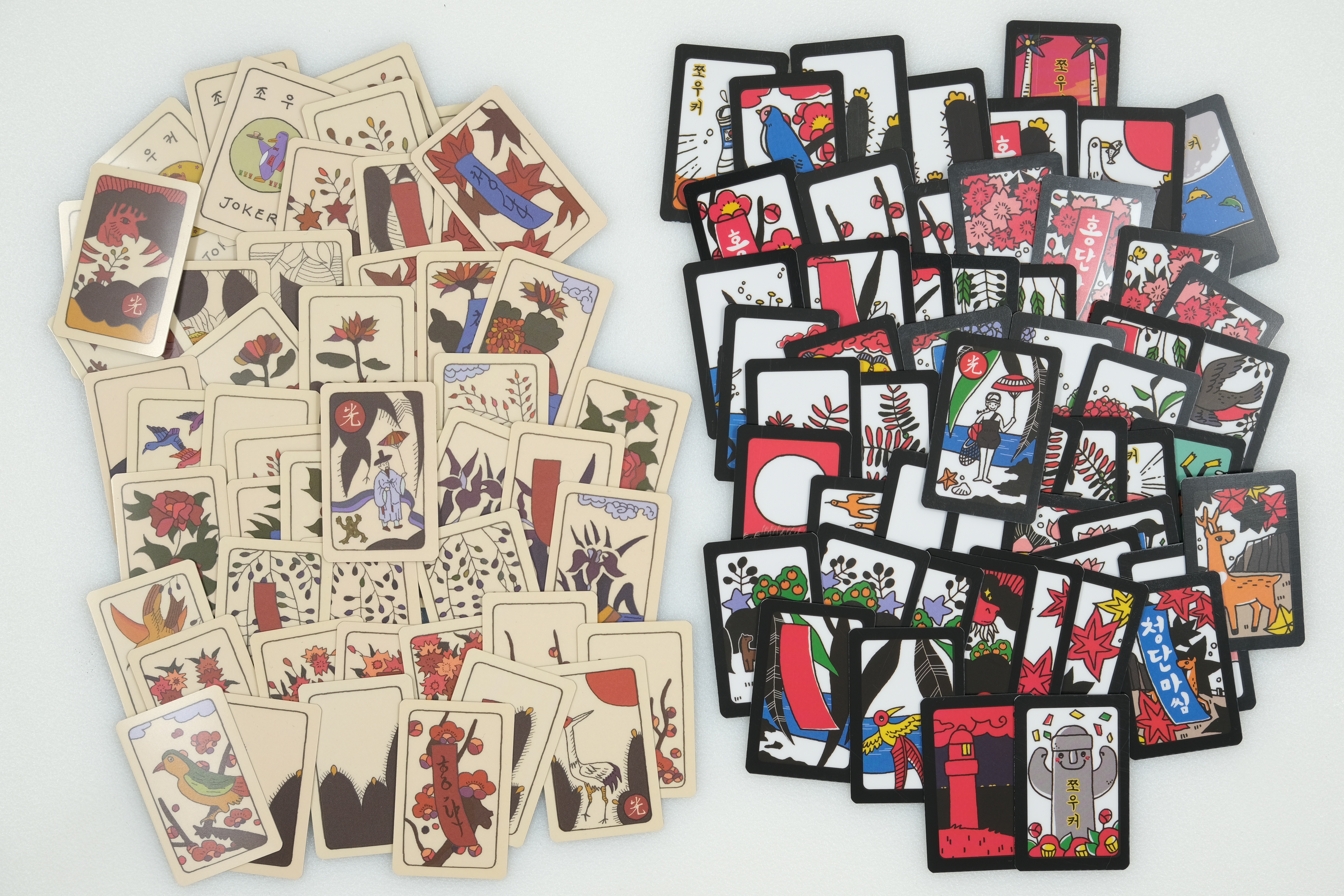
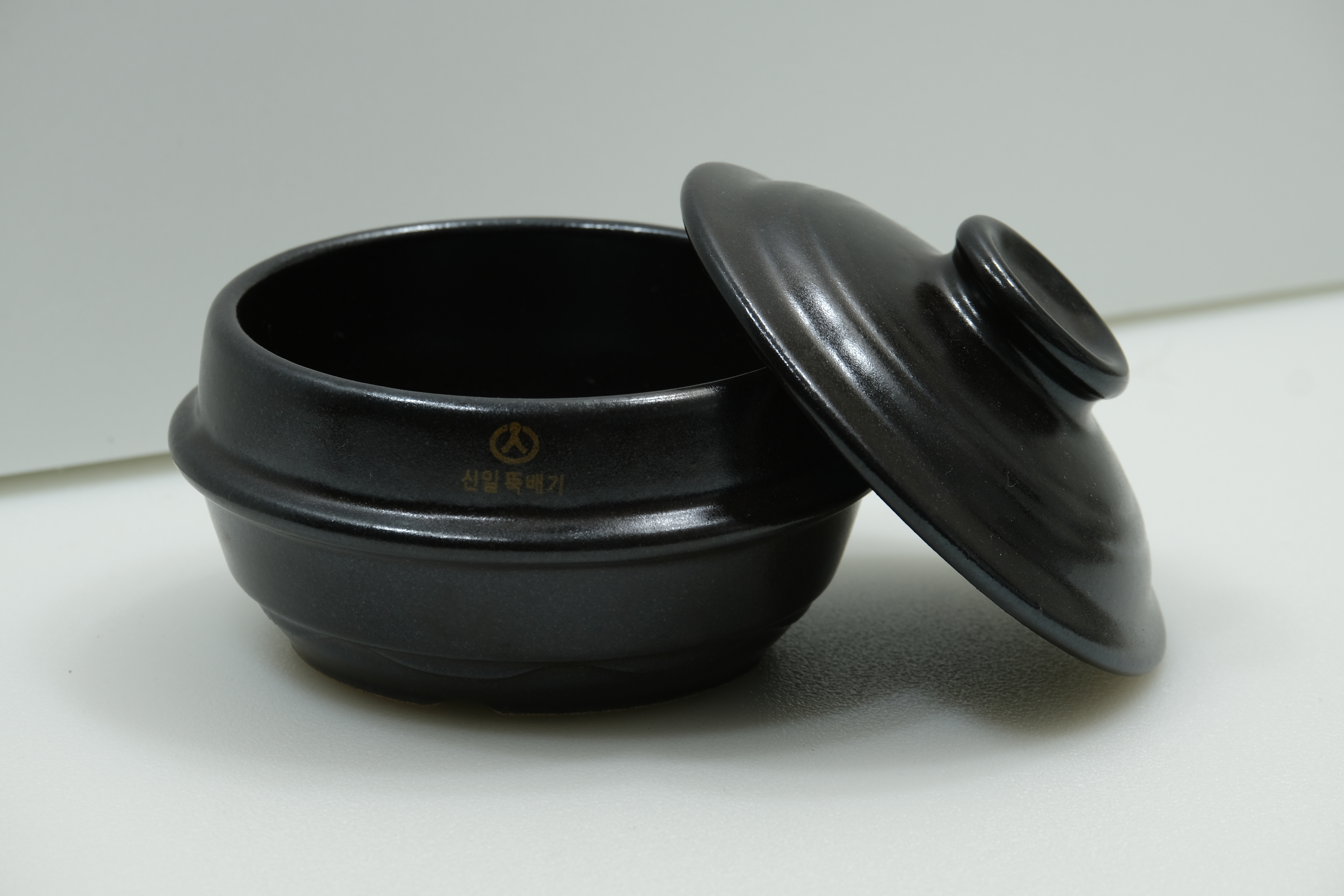
And a cute 뚝배기 from Kim's Home Center.
Conclusion (§)
omg look at how much time I spent writing this when I could have been studying instead!
I have been very busy for the past few months and felt overwhelmed most of the time. I have been slowly adding to this article up to and including October 5. So I don't feel I have written this out as well as I'd like, and I wonder if my pessimism got a little bit way too strong for a moment there.
Just today, I passed a group of 할머니 at the farmers market, so I said 안녕하세요 and 좋은 하루 돼세요. Merely an hour later, I was introduced by a mutual friend to another neighbor of Korean background, who coincidentally happened to be walking by, who said she doesn't have enough people to practice with. I really think I need to be the one to start this 모임, so I am working on a poster and looking for spots to post it.
Contact me: writing@voussoir.net
If you would like to subscribe for more, add this to your RSS reader: https://voussoir.net/writing/writing.atom